Monday, February 4, 2013

Week 52: A Journey to Korea

I approached this week’s plan for Korean cuisine with great anticipation.  I will always remember the first time my friend Vanessa took me into the heart of New York’s Koreatown for dinner.  I had never experienced such sensory satiation as I watched small dishes fill our table, felt the warmth of the grill in the center of the table, listened to the bustle of the servers keeping tables filled, smelled the spices, and tasted each dish.  When we finished our meal, I gazed in wonder and awe at the whole of my experience.  What were all of those little dishes?  Was there a rhyme or reason to them?  How could anyone possibly manage to serve so many dishes in such a short amount of time?  For this week’s project, I set out to answer those questions by planning and preparing an authentic Korean meal.

To begin my preparations, I studied the table settings and structure of Korean meals in the Korean Royal Courts.  During the Joseon period (1392 – 1897), the royal palace placed significant importance on culture and societal gatherings which resulted in the court’s focus on Korean cuisine and etiquette.  While a commoner’s diet consisted of seasonal dishes, the Royal Court insisted on serving the finest specialties from across the country.  Its banquets featured delicacies from each of Korea’s eight provinces each month.  The court even created official positions related to the procurement of the ingredients necessary to feature such dishes.  Five meals were served daily, and the main meals included an elaborate setting (bansang) of rice, soups, stews, vegetables, meats, and side dishes.  The number of side dishes, or banchan, dictates the setting of the table as a 3 cheop (cheop meaning the number of side dishes), 5 cheop, 7 cheop, 9 cheop, or 12 cheop.  Unlike a Western meal served in courses, Korean meals are served in one large course.  The dishes are arranged according to guidelines designed to organize them in categories.  Examples of these guidelines include setting cold dishes on the left, soups and stews on the right, vegetables and rice on the left, kimchi at the back, and sauces in the front.  Utensils, a spoon and chopsticks, are set to the right of the diner.  In other words, this is a “rules” cuisine, which makes it so much more complicated than the covered-dish suppers of my youth. 

As mentioned above, the number of banchan served can vary significantly at a Korean dinner, and in general, more formal meals include a larger number of banchan.   Several categories of small dishes varying based on ingredients and style of preparation make up the whole of a banchan presentation. 
  • Kimchi:  Likely the most popular category, it is in its most basic form fermented vegetables.  Most people are familiar with kimchi made from napa cabbage; however, boundless versions of the dish exist including different vegetables, varying times of fermentation, and the amount of chilis used for heat.  No Korean meal is complete without at least one presentation of kimchi, and most include more.
  • Namul:  Vegetables that have been steamed or stir-fried and seasoned.  
  • Bokkeum:  A dish that has been stir-fried with a sauce.
  • Jorim:  A dish simmered in a seasoned broth.
  • Jjim: A steamed dish.
  • Jeon:  A pan-fried dish.
While these are the main categories, there are a few other dishes that may be served as banchan, such as japchae (glass noodles served with vegetables and beef) and Korean-style potato salad.  Understanding these categories of dishes proved to be the most powerful lesson of this week’s blog for me.  What seemed a barrage of small dishes at a Korean table suddenly has transformed into a more meaningful, thoughtful presentation.
 
Never one to back down from a challenge, I took all of this information and formulated a menu for four people, which included rice, a clear broth soup (guk), a stew (jiggae), two secondary main courses featuring grilled meats, three kimchi presentations, and other banchan that featured vegetables in cold and hot presentations.  It would’ve been nice to stay true to the Korean way of presenting the full meal all at the same time, but I don’t have a workforce in my kitchen beyond me (and the hubs) so this meal would definitely have to be presented in a few courses.  I did commit to serving the secondary main courses and full array of banchan at the same time though, and that felt like a real accomplishment in and of itself.
 
kimchi
While I knew that many types of kimchi existed, I did not understand what a significant role kimchi plays in Korean cuisine.  It’s not just a salad or a relish.  For the project, I wanted to make several versions so that I could experience the differences.  I made the kimchi several days before our meal to allow it time to ferment, but in reality, some of these kimchis would've been even better if they had been made several weeks before the meal. 
 
kkakdugi, dongchimi, baechu kimchi
I made three versions.  For the baechu kimchi, which is made with Napa cabbage, I seasoned it with garlic, ginger, fish sauce, grated daikon, scallions, and gochugaru (Korean red pepper powder).  I also made kkakdugi, which is made with cubed daikon, and I seasoned it with gochugaru, fish sauce, raw shrimp, garlic, ginger, and glutinous rice powder.  Because these two kimchis had similar seasonings, the flavors were comparable, but it was interesting to taste the differences based on the use of the cabbage or the daikon.  The one made with cabbage definitely had more bite, which is probably because the cabbage released less water than the daikon.  The third kimchi that I made is called dongchimi or radish water kimchi.  It presented a completely different profile than the others.  Water kimchis are considered “quick” kimchis, because they require less time for fermenting.  They are more watery and offer a lighter flavor.  The recipe I followed included daikon, sugar, napa cabbage, salt, thinly sliced chili peppers, scallions, and a puree of Asian pear, garlic, ginger, and onion.  I loved this one!  It offered a light, refreshing balance when served with grilled meats for our dinner.  We enjoyed all three with our meal.
 
duk guk
duk guk
Guk refers to soups that feature vegetables, seafood, and/or meat in a clear broth.  Even more specifically, guk is categorized into four different groups based on the ingredients used to make the broth.  For our dinner, we began with duk guk (also spelled tteokguk), a dish traditionally eaten on New Year’s Day.  Duk refers to a thinly sliced rice cake.  These rice cakes are white, and the custom of eating this dish on New Year’s Day originated from the idea of the white duk representing purity and bringing good fortune in the new year.  For my presentation, I sautéed garlic and ginger in a large pot for about a minute and then added beef broth.  When the broth came to a boil, I added the rice cakes.  (I purchased frozen rice cakes at Vihn An.)  Just like gnocchi, the rice cakes are finished cooking when they float to the top of the pot.  When they were finished, I turned off the heat on the stove and added fresh scallions to the pot.  To serve the dish, I labeled the soup into individual bowls and topped it with the traditional garnishments of thinly sliced fried egg, roasted seaweed, and roasted sesame seeds.  I liked the flavors of the broth with the garnishments, but I wouldn’t make the guk with rice cakes again.  I found them overly chewy and not very flavorful.  Perhaps I didn’t cook them long enough or maybe fresh ones would have had more flavor.  I don’t know.  I do know that everyone else at lunch disagreed with me and liked them, so it may just be an issue of personal taste.  Nonetheless, I was more than happy to slurp every drop of the broth out of my bowl.
 
haemul sundubu jjigae
Jjigae is a stew.  Many varieties exist, and their names differ based on their principle ingredients and seasonings.  The dish is served in a large communal hot pot.  Kimchi jjigae appears to be the most popular variation of the stew as there were more returns for it than any other versions when I performed a quick internet search for “jjigae,” but another version called haemul sundubu jjigae that features seafood, meat, and silken tofu intrigued me.  I thought the combination of ingredients was unusual, and I couldn’t resist experiencing the dish for myself.
 
The base of the stew is anchovy broth.  I must admit that this was a tough start for me.  As much as I pride myself in being adventurous when it comes to food, I just don’t like anchovies.  I’ve tried to like them.  I want to like them, but it just isn’t happening.  Unfailingly, I am presented with anchovies at a tasting about once a year, and each time I think that it will be the turning point moment when I finally like them.  Then, I take a bite and immediately wish I hadn’t.  Nevertheless, this jjigae recipe began with anchovy broth, so I bought some freeze-dried anchovies at a local market and made an anchovy broth.  I survived…that’s all I’ll say about it.
 
haemul sundubu jjigae
Now, for the good part…the stew!  I began by warming gochugaru and sesame oil over medium heat until a paste formed.  Then, I added thinly sliced strips of beef sirloin, diced onion, garlic, and soy sauce, and I cooked the mixture for a few minutes.  I poured anchovy broth over the mixture and brought it to a boil.  Then, I added large chunks of silken tofu and diced, fresh zucchini to the mixture and brought it to a boil again.  When it reached the boiling point, I added shrimp and clams to the stew and cooked it just until the clams opened.  Then, I added chopped scallions and turned off the heat.  At the table, I cracked an egg into the stew just before we began ladeling it into our individual bowls.  This was my favorite dish of the day!  I loved it so much that I would even suffer through making anchovy broth again.  The tofu added an interesting richness and texture to the stew, and the rich flavors from the chili powder and sesame oil complemented the seafood well.  When I make it again, the only thing I will change is the timing of adding the shrimp.  It was a little overcooked.  I think it would’ve been cooked perfectly if I had added it when the first clam opened, instead of adding it at the same time as the clams.  All in all though, a stellar dish!
 
banchan
gyeran jjim, modum bausut bokkeum
sigeumchi namul, baechu kimchi
kkakdugi, dongchimi
After careful consideration, I selected banchan from three categories to accompany the three kimchis.  I purposely selected side dishes that did not include meat or fish, because I needed to balance the meat and seafood in the jjigae and the grilled meats I was serving as secondary main courses.  (I am making a point to explain this because I don’t want my selections for banchan to mislead someone into thinking that banchan are vegetable side dishes.  In fact, many banchan dishes feature fish.)  From the namul category, which includes vegetables that have been steamed or stir-fried and then seasoned, I made a spinach dish called sigeumchi namul.  The dish is one of the most common namuls.  I included it because it can be served at a cool temperature, and I wanted to make sure I served a cold dish.  Quite simply, I blanched spinach in salted boiling water for less than a minute, moved it into a bowl of ice water, drained it, and then seasoned it with scallions, gochujang (Korean chili paste), soy sauce, garlic, sugar, sesame oil, and toasted sesame seeds.  I’d make this dish for any occasion, because it presents an interesting combination of complex flavors yet I found it light and refreshing.  From the bokkeum category (stir-fried dishes with a sauce), I made modum bausut bokkeum, which is quite simply stir-fried wild mushrooms.  I selected this because it was easy.  Mushrooms release so much moisture when stir-fried that they basically create their own sauce.  I used a mixture of oyster, shitake, and portabella mushrooms.  My third choice for banchan was from the jjim (steamed) category and called gyeran jjim or steamed silken eggs.  I hadn’t considered eggs as a “steamed” dish, so I was intrigued when I found several references to it.  It’s a simple dish of eggs, water, gochugaru, garlic, scallion, sesame oil, and toasted sesame seeds poured into a ramekin and steamed.  (It can also include salted shrimp.)  Placing the ramekin in a steamer basket insert is the most traditional way to steam it although I found several references on Korean blogs to cooking it in the microwave.  The end result is a delicious dish with a custard-like texture.
 
beef bulgogi and sam gyeop sal

beef bulgogi, sam gyeop sal
Since I don’t have one of those cool tables with a charcoal grill in the middle, we grilled our beef bulgogi and sam gyeop sal outside and brought them inside for the feast.  Making these dishes at home makes me appreciate the ingenuity of creating those special tables.  With such thin slices of meat, it is nearly impossible to cook on a large grill for a crowd unless you want well done temperatures on the meats.  It cooks almost immediately.  Next time, I may just invite my guests to stand around the charcoal grill and cook their own.
 
sesame salt, gochujang
soy sauce, asian pear dipping sauce
For the beef bulgogi, I used Mark Bittman’s recipe from a June 2011 NYT Magazine article I saved.  I sliced sirloin steak thinly and marinated it for a few hours in a mixture of scallions, garlic, sugar, black pepper, soy sauce, and sesame oil.  For the sam gyeop sal, I followed Steven Raichlen’s recipe based on a version he had in Seoul.  I sliced pork belly as thinly as possible (not an easy feat), and we served it grilled with an Asian Pear Dipping Sauce (Asian pear, garlic, fresh ginger, scallion, sugar, salt, sesame oil, rice vinegar, gochugaru, and gochugang), sesame salt (salt, black pepper, and toasted sesame seeds), soy sauce, and gochuchang.  We filled lettuce leaves with the grilled meats and grilled garlic cloves, red chilis, and onions.  The pear dipping sauce was absolutely delicious.  Raichlen explains that the proper way to enjoy the pork belly is to dip it in the sesame salt and then in the pear dipping sauce.  The combination was great, and it was a nice accent to the pork.  There was not a single morsel left on the table when we finished, so I have to believe that we did something right.
 
What a meal!  I’m still surprised that I managed to organize so many dishes for one meal.  (Of course, having the hubs there to grill everything helped.  Plus, our friends Patrick and Stephanie were not shy about pitching in.  Patrick kept our glasses full of perfectly-paired beers, and Stephanie stir-fried the mushrooms for me.)  I must admit that I enjoyed the research for this week’s cuisine as much as the food.  It’s a fascinating approach.
 
I can’t think of a better way to end my 2012 project!  For those of you who read these blog posts and shared your thoughts with me, thank you.  This project was truly a life-changing experience.  It presented me with incredible opportunities to connect with lifelong friends, co-workers, fellow Miami food aficionados, and bloggers around the globe in a way that I never expected.  I have yet to decide on 2013’s project, but I can assure you that there will be more dishes and blog posts to follow.

Wednesday, January 23, 2013

Week 51: A Journey to Ukraine

When planning the year’s fifty-two countries, I realized that some countries would overlap by design.  I just assumed that in the end, there would be plenty of dishes to cover in a week’s time despite the number of similar countries in the mix.  In light of that decision, I found myself in a quandary when I saw “Week 51: Ukraine” on my schedule.  To date, I had already covered Russia, Poland, Romania, and Hungary, and borscht was the only dish that I felt was missed.  Longing to take it easy while enjoying the holidays and my time in Tennessee with family, I almost allowed myself a tiny sabbatical from the project, but then I thought, “It’s Week 51.  I’ve almost made it to the end.  I can do this.  I just need a little inspiration.”  I found that inspiration from my Ukrainian friend and co-worker, Greg.  I ran into him in the break room on the week before Christmas and told him I needed help choosing some dishes from Ukraine for the project, and within thirty minutes, I had a list of frantically written notes and an email inbox filling with pictures and recipes that reflect authentic preparations of traditional dishes.  These moments are the ones I cherish most during the project.  Nothing compares to hearing someone enthusiastically share his culture, his homeland, and his family with you.  When I finally sat down and summarized our conversation, I had these notes to plan my week of Ukrainian dishes:
  • Borscht:  A must try.  There are more versions than imaginable, so just pick one that sounds good.  Green borscht, made with sorrel and no beets, is a favorite in Greg’s family, but finding fresh sorrel in the winter is difficult. Make a meaty borscht with red beets.  It should be sour.  Greg likes his borscht so thick that a fork will stand up straight in the bowl, but his dad likes it very brothy.  Either way is right, so make it as I like.
  • Varenyky and Perohy:  Varenyky are similar to pierogi.  They can be filled with anything….mashed potato and onion, liver, or even cherries.  Perohy are also dumplings stuffed with the same types of fillings, but they are very small…the smaller the better.  A cook who can make the tiniest of perohy is revered.
  • Greg’s Ukrainian Appetizer:  While he didn’t know the English name for the dish, he explained that most Ukrainian restaurants cook peas in lard, mash them with garlic, salt, and pepper, and serve it on Russian black bread as an appetizer.  He also explained that in the Ukraine this would more likely be made with kidney beans than peas.
  • Blintz:  Make with ground meat and onion like you’d use in shepherd’s pie.  Roll like a tamale, not like a crepe.  Fry in lard to crisp the edges.
  • Kiev:  One of the most famous dishes from Ukraine.  A definite must.  Serve it with potatoes.
  • Vinigret:  Greg’s dad’s favorite dish.  A salad made with beets.  Very important to cut up all vegetables in the same sizes.
  • Olivye:  A salad served at EVERY special occasion. 
  • Latkes:  A family favorite.
  • Pork:  They eat lots of it.
  • Sour Cream:  Serve it with everything.
From this list, I organized a plan to integrate Ukrainian cuisine into my post-Christmas holiday.  Greg’s enthusiasm boosted my spirits, and I must say I thoroughly enjoyed thinking of him and his family as I cooked these dishes.
 
borscht
Despite my adoration for roasted beets, I never found the idea of borscht appealing.  In full disclosure, I knew nothing about it beyond the fact that it was a beet stew, its pink coloration in photos reminded me of Pepto-Bismol, and its mention summoned images of a circa 1950s housewife trying to impress her husband’s boss at a dinner party.  I was so wrong. 


borscht
Borscht is not really a dish as much as it is a category of Eastern European stews.  It may be hot or cold, vegetarian or meaty, hearty or brothy, and with beets or without beets.  I must note, though, that its name is derived from an old Slavic word for beets, borsch, so it likely began as a beet stew and evolved into many different variations over time.  In actuality, borscht is best described as a vegetable soup made with rich beef or pork broth.  In many cases, roasted beets are shredded or cubed and added to the soup.  The reason those “Pepto-like” photos exist is because many of the cold versions have sour cream mixed into the soup.  After Greg told me how much he loves “Green Borscht” made with sorrel and no beets, I considered sourcing fresh sorrel online to make it, but instead, I chose a traditional version for my first borscht.  After reading several recipes, I determined that one posted by Alan Leonetti on food.com for his Ukrainian grandmother’s recipe best represented an authentic preparation.  The recipe begins with rendered bacon and beef chuck browned in the bacon fat.  The meat is removed, and carrots, onions, garlic, oregano, dill, and bay leaves are sautéed in the fat.  Then, red wine vinegar is added to deglaze the pot, and the beef, bacon, and some water are added back to the pot to simmer until the meat is tender, which is about two hours.  When the meat is tender, roasted beets, potatoes, cabbage, parsley, tomato paste, celery seed and salt are added and simmered for another thirty minutes.  Finally, red wine vinegar, salt, pepper, and sugar are added to taste, and the borscht is served with a dollop of sour cream and fresh dill.  The complex harmony of sweet, savory, sour, hot, cool, tangy, creamy, and tangy elements produces a lovely, rich broth with an irresistible flavor.  I couldn’t believe how much I loved this dish.  It was unbelievably delicious.

blintz

blintz
When someone says “blintz” to me, I think of something similar to a French crepe stuffed with sweet cheese and possibly fruit.  If pressed to define them further, I might add that it is also similar to a blini and is sometimes served with crème fraiche and caviar.  When Greg suggested that I make blintzes for this week’s project, I was a bit confused and surprised when he said that I should “make it with ground meat and onion like you’d use in a shepherd’s pie, roll it like a tamale, not like a crepe, and fry it in lard.”  I found a basic recipe for the batter (milk, eggs, oil, and flour), and with Greg’s notes, I set out to make blintzes.  I rolled and stuffed the thin pancakes with ground pork and onion.  Then, I dredged them in an egg wash and bread crumbs before frying them in some lard.  I served them with a dollop of sour cream and fresh parsley, and they were quite satisfying.  My favorite part of the dish was the crispiness of the pancake edges as a result of dredging them in egg wash and breadcrumbs before frying them.  It added a nice texture next to the filling.  I also enjoyed the addition of the fresh parsley and cool sour cream, which offered a light counterpoint to the rich pork and onion filling.  I can see how this would be a great lunch on a cold, winter’s day.

vinigret
vinigret
Vinigret is a beet and potato salad dressed with oil and vinegar.  When Greg mentioned that it is his father’s favorite dish, I knew it would be worth my time.  After reading several recipes for it, I quickly recognized that the most important element of the salad is not necessarily the ingredients, but the precise size of the ingredients.  Each component of the salad should be diced into small cubes.  On the night before I planned to serve the salad, I boiled a large potato, two beets, and a carrot until they were tender.  When they were cool enough to handle, I peeled them and stored them in the refrigerator overnight so that they would be easier to dice the next day.  When I was ready to assemble the salad, I diced the potato, beets, and carrots, along with onion and dill pickles.  I mixed them with sauerkraut, and then I dressed the salad with olive oil and white vinegar and seasoned it with salt and pepper.  (Sunflower oil would have been a more authentic choice, but I didn’t have any on hand.)  The brightness of the vinegar, pickles, and sauerkraut elevates the root vegetables into a light, refreshing salad.  The small dice of the vegetables allows for each bite to include a bit of sweet carrot, earthy beet, silky potato, crispy pickles and onions, and sour pickles and sauerkraut.  I can see why Greg’s dad is such a fan of this salad. 

kiev
chicken kiev served with
mashed potatoes and peas
Although I’d heard of Chicken Kiev, I really didn’t know much about it.  I knew it was famous, but I had no idea why.  As it turns out, the Russian aristocracy in the late seventeenth century was enamored with French fashion and food, and aristocrats sent their chefs to train in Paris or hired French chefs to serve in their households.  A French chef named Nicolas Appert, who is also credited with the invention of canning to preserve foods, invented the dish, which is best described as a flattened, boneless chicken breast rolled around a chilled piece of herbed butter, breaded, and fried.  The dish gained popularity in Russia and was called Chicken Supreme.  I found two explanations regarding the dish’s name, Chicken Kiev.  One source states that New York restaurants in the early twentieth century named it Chicken Kiev to encourage Russian immigrants to patronize their restaurants, and another source states that Russian immigrants referred to it as Chicken Kiev as a way of referencing that it was chicken prepared in the style of what they remembered from Kiev.  Either way, this dish with French roots emerged from Ukraine as a representation of its style. 

Although its components are simple, assembling Chicken Kiev is not an easy task.  The key to successfully preparing the dish is rolling the chicken so tightly around the butter that it cannot escape while frying.  If properly prepared, a distinctive “poof” of air releasing can be heard when cutting into the center of the roll.  After several attempts to roll the chicken tightly, I gave up and tied mine with cooking string.  I’m not sure if that’s considered cheating, but I knew that my rolls would never stay together enough to achieve the necessary “poof” without a little help.  Cheating or not, it worked.  I leaned in closely as I cut into my first piece of Chicken Kiev, and sure enough…I heard it.  I sighed with amazement.  Everything worked like it should.  The chicken was moist; the breading was crisp; and the compound butter pooled onto my plate and provided a perfect elevation of flavor.  I cannot say that there was anything particularly different or interesting about the flavors here, but the simplicity of the ingredients and the technique for preparation certainly result in a well-cooked piece of chicken, which is not always as easy as some might think.

 
What a rewarding a week!  I wish I’d found more time to make the other dishes that Greg recommended, but I tried enough dishes to end the week with a newfound appreciation for the cuisine of Ukraine.  Without question, the borscht surprised me most as I never expected to find it so full of flavor.  All in all, I enjoyed every dish this week, and yet again, I remember why I began this project.  It’s a journey of discovery and overcoming misconceptions, and these Ukrainian dishes certainly provided opportunity for both.


Monday, January 21, 2013

Week 50: A Journey to Nicaragua

I must admit that I am guilty of living in a city full of fritangas yet I knew nothing of Nicaraguan cuisine until I embarked upon this week’s culinary journey.  While I was a bit embarrassed to admit how little I knew of Nicaraguan cuisine, I felt better when I began asking friends who grew up in Miami, Columbia, and Venezuela who also didn’t know.  Apparently, I hadn’t asked the right friends, because as soon as I began my research and started posting photos of my dishes on twitter and instagram, I discovered a group of people professing their love for nica food.  Like other South American cuisines, Nicaraguan cuisine is rooted in dishes from pre-Colonial times that focused on local crops.  Corn is a key ingredient in many of its most popular dishes, including beverages and desserts.  In addition to consuming common cuts of beef and pork, Nicaraguan dishes contain many of the offals, such as udders, stomachs, brains, testicles, and hoofs, plus more exotic species such as lizards, armadillos, boas, and turtle eggs.  To say the least, I had plenty of options when planning this week’s menus.  I focused on cooking Nicaragua’s most famous dishes, and although many are similar to other South American dishes, understanding the nuance of the Nicaraguan approach proved both satisfying and intriguing.

gallo pinto
gallo pinto
Gallo pinto is the national dish of Nicaragua.  This simple dish of rice and red beans seasoned with onions, bell pepper, and garlic is well known in Nicaragua and Costa Rica, and both countries claim to be the origination point of the dish.  The name translates to “spotted rooster” which describes the speckled appearance of the beans and peppers in the rice.  Nicaraguans enjoy this dish on a daily basis for breakfast, lunch, and dinner.  I liked it, but in all fairness, it didn’t seem any different to me than other basic red beans and rice dishes I’ve tried in the United States.  If someone simply presented it to me with no context of origin, I would assume that it was a vegetarian version of Louisiana Creole red beans and rice.  That is likely due to my Southern American heritage.  Regardless of which country the dish represents, I would be happy to enjoy it on a regular basis…but maybe not daily.

indio viejo
indio viejo
Indio Viejo is a traditional Nicaraguan dish dating back over five hundred years.  The dish only uses ingredients native to Nicaragua, such as tomatoes, sour oranges, achiote, corn, mint, and beef.  Legend states that the stew’s namesake, which translates to old Indian, can be traced back to the days of the Conquistadors.  When the local conquistadors learned that native Nicarao celebrated a tradition of providing food for anyone who asked, they took advantage of the communities and constantly appeared at their feasts in large numbers devouring most of the food and leaving little for the natives.  At one such feast, a conquistador asked the man tending to the pot of stew on the fire what he was cooking, and the man responded, “It’s just an old Indian who passed away recently.”  As the conquistadors quickly left the party, the natives laughed and continued with their party.  Hence, the name.

The dish includes beef that is boiled in water and sour orange juice until it is tender enough to shred with a fork.  Tomatoes, onions, peppers, and achiote flavor the stew, and corn tortilla dough is added to thicken the stew.  My understanding is that the stew should have a consistency similar to polenta as result of the corn tortilla dough added to the dish.  I read several accounts stating that cornmeal is often used in place of tortilla dough.  I opted to make my version with cornmeal, but I don’t think my dish reached the proper consistency.  I kept adding water in hopes of “plumping” the cornmeal, but somehow it never soaked in enough to be creamy.  Instead, my version was gritty.  I think the root of my problem is that someone more familiar with Nicaraguan cuisine would’ve known that the direction to “substitute cornmeal” meant to substitute the finer ground masa harina, not regular cornmeal.  If I try to make the dish again, I will actually make some tortilla dough to attempt a more authentic result.  On a positive note, the flavor of the stew was delicious.  I was surprised at how well the flavor of the sour orange paired with beef.  All in all, it wasn’t a complete disaster, but I definitely need to work on it.

vigorón
vigoron
Vigorón is a popular street food in Nicaragua.  The dish originated in Granada in the mid-twentieth century, and its popularity quickly spread throughout neighboring countries.  The dish begins with a plantain or banana leaf used as a vessel for serving boiled yuca topped with a cabbage salad called repollo and chicharrones.  While the concept of the dish is simple, the repollo varies among vendors and family recipes.  Repollo is a pickled cabbage slaw commonly served as an accompaniment to Nicaraguan meals.  A basic repollo includes shredded cabbage, grated carrot, chopped tomatoes, lime juice, red pepper flakes, and scallions.  In most cases, the salad is left to ferment for a few hours or several days to develop the flavors.  (For my vigorón, I made repollo and allowed it three days for fermentation.)  Although the dish is simple and compact, it truly ignites the senses with a variety of textures and flavors.  The yuca provides warm, creamy, and sweet elements, while the repollo offers sour, cool, and slightly crunchy textures next to the rich and crunchy chicharrones broken into bite size pieces.  I found the use of a banana leaf as a vessel for easy “fast food” transport to be a clever idea, as well.  Of all the Nicaraguan dishes I prepared this week, this one definitely stands apart for its ingenious juxtaposition of simple and complex flavors.

nacatamales
nacatamales cooking
in a pot of boiling water
I am a huge fan of tamales.  I rarely pass up an opportunity to order a tamale, but in all honestly, I always get to the center of that delicious cornmeal dough and wish that the small, thin layer of pork was just a little thicker…a little larger…a little heartier.  When I began reading about nacatamales, I was intrigued on several levels.  For starters, I loved the idea of wrapping a tamale in a plantain leaf (or banana leaf in my case), instead of a corn husk, because I knew that would impart an interesting flavor.  Beyond that, nacatamales presented a full realization of my desire to open a tamale and find thick layers of meat and vegetables with my pillow of cornmeal dough.  So, I set out to make nacatamales. 

The dough is made with masa harina, lard, sour orange juice, and broth (I used chicken broth).  I found a broad assortment of recipes for the dough.  The simple recipes included instructions to make the dough and let it rest for thirty minutes.  The more complicated instructions included a process of cooking the cornmeal in water and orange juice over low heat, rinsing it with cold water, placing it in fresh water and resting it for three days with daily water changes.  Even though the latter option presented a few more steps, I decided to try it because it “seemed” authentic and I thought the longer rest time would result in a stronger flavor. 

Upon reading lists of ingredients used in nacatamale fillings, I immediately recognized that the genesis of this dish must have been a cook looking to transform leftovers into a new dish.  The filling includes mashed potatoes, cooked rice, and pork.  For the mashed potatoes and cooked rice, I planned ahead when I was making them earlier in the week and made extra.  For the pork, most recipes called for “cubes” of pork butt, so I braised a pork butt earlier in the week and refrigerated it so that it would be firm enough to cut into cubes.  On the day that I assembled the nacatamales, I sautéed bell peppers, onions, garlic, achiote, tomatoes, fresh mint, and fresh parsley until the vegetables were tender.  Then, I mixed in the pork, potatoes, and rice.


nacatamale filling
After three days of attending to the dough and prepping the filling ingredients, I was more than ready to start assembling these little bundles.  I cut banana leaves into 16-inch squares and placed one cup of dough in the center of the leaf. I added a heaping spoonful of filling on top of the dough, folded the leaf around it, and tied it with string.  Then, I dropped the nacatamales in a large pot of boiling water, cooked them for thirty minutes, removed them from the pot, and let them rest for about five minutes.  When I finally had the opportunity to unwrap my first nacatamale, I discovered a little package of goodness just as delicious as I had imagined.  Wow!  The dough not only maintained its corn flavor, but it also took on the pungency of the banana leaf and the full flavors of the pork and vegetables.  Without question, this dish was the most flavorful and satisfying of the week.

tres leches
tres leches
Tres leches is a popular dessert in most Central American countries, and since moving to Miami, I have definitely eaten my fair share of it.  During my research, I discovered that many culinary historians believe the cake originated in Nicaragua.  The dessert is actually quite simple.  It begins with a white cake.  When the cake has cooled from baking in the oven, small holes are pricked throughout the cake and a mixture of whole milk, evaporated milk, and sweetened condensed milk are poured over the cake until it cannot absorb anymore.  (This reminded me of the infamous 1980s craze for pudding cakes.)  The last step is to add a simple white frosting and serve.  Interestingly, most recipes that I found called for a frosting made with whipping cream and sugar, but when I was discussing the recipes I’d read with a co-worker from Venezuela, she explained that a more authentic frosting would be one made with egg whites and sugar.  She pointed out that whipping cream would be too expensive for most people, and everyone had access to eggs, which is why so many cakes made in Central America have that fluffy, white meringue-style frosting.  I topped my tres leches cake with a thin layer of frosting made with egg whites and sugar.  I was very happy with the flavor, and the texture of the cake with the soaked milk was exactly like ones I’ve tried in local restaurants.  A definite success!

Although I enjoyed all of the week’s dishes, none compared to the nacatamales.  If I learned nothing else, I learned that this dish presents the best reincarnation for leftovers I ever imagined!  Fortunately, I did learn much more, and I ended the week with a newfound respect and understanding of Nicaraguan cuisine.

Friday, January 4, 2013

Week 49: A Journey to India

Indian cuisine offers a diverse presentation of dishes defined by their ingredients, cooking methods, religious connections, and regional origins.  While the original Indian diet dating back over five thousand years was simple, the introduction of spices by traveling salesmen and invading countries spurred the evolution of the more complex dishes we recognize as Indian cuisine today.  The introduction of Buddhism, Hinduism, and Islam influenced Indians’ culinary choices, as well.  With such a breadth of options, I found myself struggling to create menus for this week’s project, so I selected dishes that were outside the norm of my normal Indian dining regimen.  

Vegetarian Dinner
Because vegetarianism is a common way of life for many in India, its cuisine offers numerous options for hosting a legitimate vegetarian meal.  By that, I mean a menu with thoughtful dishes presented in a manner that celebrates their ingredients, instead of dishes obviously conceived as meat dishes with substitutions.  After planning the menu, I invited over a few friends (one, a vegetarian) for a fully vegetarian Indian feast.

 
homemade paneer
On the morning of our dinner, I began my day by making homemade paneer, which sounds impressive, but it’s really quite simple.  I boiled whole milk, added lemon juice, turned down the heat, simmered it for about a minute while the curds and whey separated, strained it into cheesecloth, rinsed off the lemon juice with some water, and let it drain for about five minutes.  Then, I shaped it into a round and set a heavy pot on it so that it could mold into a block of cheese.  When I came home from work that night, the cheese was perfect and ready to be cut into cubes for palak paneer.

papadum and tomato raita
My friends arrived for dinner bearing gifts.  Katrina brought a nice bottle of wine.  Debra brought an amazing homemade tomato raita, and Sweet Pea brought frozen papadums that can be microwaved to a perfect crisp.  (I didn’t even know that these little frozen gems existed, and I must say that I was skeptical until we popped them in the microwave.  Wow!  I couldn’t believe my eyes or my taste buds!)  Never a host to say “let’s save these for later,” we immediately began our meal with their gifts!  When we finished our papadums and raita, I served palak paneer, chana masala, and basmati rice that I lightly infused with cinnamon and cloves. 

palak paneer
Having ordered palak paneer and saag paneer many times in Indian restaurants, I actually never knew the difference in these dishes.  After a little research, I discovered that palak paneer is only made with spinach, but saag paneer may be made with any greens and is commonly made with a combination of greens, such as spinach and fenugreek greens.  With this information, I confidently set out to make palak paneer.  I couldn’t find one single recipe that seemed to include all of the necessary elements, so I combined a few different recipes to achieve the right combination of flavors.  For the sauce, I used fresh garlic, fresh ginger, ground coriander, ground red pepper, finely ground cashews and poppy seeds, onions, diced tomatoes, turmeric, sugar, cinnamon, and cloves.  When the sauce was simmering, I added the blanched spinach, and just before serving, I stirred in the cubes of homemade paneer and cooked it long enough to heat through the cheese.  Without question, this was the best palak (or saag) paneer I have ever tasted.  I used a full tablespoon of cayenne pepper, so it definitely had heat, but beyond that, I could taste the difference in using fresh spinach, garlic, and ginger.  Also, the consistency of the paneer was nice, firm yet creamy.  Sometimes in restaurants, I find it a bit rubbery or so creamy that it is falling apart and spreading into the sauce.  All in all, a stellar dish that I will make again.

chana masala
Chana masala is a popular chickpea dish in Northern India with a sour bite.  The chickpeas are stewed in a tomato-based sauce seasoned with onion, garlic, ginger, chili peppers, and curry powder or garam masala.  According to my research, the most authentic way to achieve the sour flavor is the addition of amchoor powder (dried unripe mango powder), but most accounts note that additional fresh lemon juice can achieve the same flavor profile.  I’m not sure what the correct flavor balance should be, but I added lemon juice and tasted the dish until I felt like the flavors were balanced.  I liked the dish, and it was especially nice alongside the very spicy palak paneer.

Friday Night Dinner for Two

chicken biryani
With so many options, I struggled to determine which dishes I should make for Friday night’s dinner.  In all honesty, I wanted to make our favorite Indian dishes (korma, tikka masala, and kadhai), but adhering to my project rules, I resisted.  Truthfully, I’ve made them all at home previously.  So, I chose to make Chicken Biryani.  While it’s one of the most famous Indian dishes around, I had never tried it.  I always thought it seemed so boring compared to the spicy curries and grilled dishes on Indian menus.  Then, I read Mark Bittman’s glowing description of it in his The Best Recipes in the World cookbook, and I decided to give it a try.  It was the most delicious version of “chicken and rice” that I have ever tasted.  In addition to achieving the most perfectly moist chicken I could imagine, the recipe’s use of onion, saffron, cardamom pods, cloves, cinnamon, and ginger creates an alluring aroma.  The dish is topped with almonds fried in butter which adds a rich, crunchy, nutty element to the dish and elevates it to another plane.  (Topping dishes with fried almonds is a trick I learned from my Palestinian friend Lana who fries slivered almonds in ghee and tops almost all of her dishes with them.)  This is truly a perfect dish for a night when comfort food is in order.  Bittman’s recipe is absolutely foolproof and delicious.


vankaya nuvvula masala
Fortunately, I made a large pot of chicken biryani, because the Vankaya Nuvvula Masala, eggplants stewed in sesame sauce, proved to be a complete failure.  In defense of the dish, I attribute the failure to my inability to select properly sized eggplants and the amount of time required to properly cook through large eggplants.  In other words, my eggplants needed to be smaller, or I needed to cook my large ones for much longer.  Despite the toughness of the eggplant, the flavor of the sauce was delicious and complex as it included onion, chilies, poppy seeds, sesame seeds, cumin seeds, ginger, garlic, turmeric, cayenne powder, coriander, and fenugreek.  For the purposes of the project, the sauce certainly offered a new flavor profile that I had not previously experienced in Indian food.  I don’t normally consider sesame seeds as representative of Indian flavors, but this dish surely changed that perspective.

With more available time, I could have cooked a different Indian meal every night this week, and still, I would’ve only scratched the surface of possibilities.  That’s one of the most appealing things about Indian food, yet I tend to always order the same dishes when I visit an Indian restaurant.  This week’s dishes inspired me to try new ones in an effort to experience the full scope of flavor profiles that Indian cuisine offers.  Fortunately, we have a great little Indian restaurant in our neighborhood for these future endeavors.

Wednesday, December 19, 2012

Week 48: A Journey to Sri Lanka

My week of Sri Lankan cuisine enlightened me to the limitless culinary possibilities this country offers.  Sri Lanka is an island nation off the southern coast of India.  While its dishes have obviously evolved though use of local ingredients, such as of tropical fruits, rice, and fish, Sri Lankan cuisine also bears the influence of Arab traders who settled there in the sixth century, as well as Portuguese and Dutch explorers who arrived in the sixteenth century.  Rice and curries are the most popular and prevalent dishes throughout the country, and Sri Lankan cuisine is most famous for its spicy profile.  Summarizing the cuisine beyond these simple points is nearly impossible, because Sri Lankan dishes are not necessarily the same throughout the country.  A basic dish may have very different presentations in the Northern and Southern Provinces, so for my purposes this week, I focused on finding authentic recipes for Sri Lankan dishes with an understanding that my dishes may not represent the entire country but certainly its spirit as a whole.

brinjal moju
brinjal moju
Eggplants grow well in warmer climates, so it is no surprise to learn that they are a common ingredient in Sri Lankan cuisine.  While many curry dishes feature eggplants, I discovered a dish called Brinjal Moju which is commonly described as a pickle in most references, but I think “relish” would be a better description of the dish.  It may be served with paratha, steamed rice, or as an accompaniment to a curry dish.  For my brinjal moju, I included eggplant, shallots, Serrano chilies, garlic, crushed red pepper, vinegar, ground mustard, rice vinegar, sugar, and cloves.  I sliced the eggplant into strips, tossed it in turmeric and salt, and let it sit for about 30 minutes.  Then, I fried the eggplant strips in coconut oil.  After removing them, I fried the shallots and Serrano peppers in the same oil.  In the meantime, I mixed the spices, sugar, and vinegar together and brought them to a boil.  When the sugar had dissolved, I removed the vinegar mixture from the stove top and mixed it together with the fried vegetables.  I let it cool to room temperature and then moved it to the refrigerator so that the flavors could meld overnight.


tamarind fish curry
tamarind fish curry
With limited time for cooking this week, I recognized that a fish curry was the most obvious and important dish to experience.  After reading dozens of recipes for Sri Lankan fish curries, I happened upon Laurie Ashton Farook’s recipe, Mama Farook’s Sri Lankan Tamarind Fish Curry, and I knew it was destiny.  Farook is a Canadian expat who has lived in Sri Lanka since 2003, and her blog chilli & chocolate serves as an incredible source for learning about Sri Lankan cuisine.  This dish is her mother-in-law’s recipe.  It begins with a marinade of tamarind paste, red chili powder, turmeric, salt, and a little water poured over white fish and sliced onions.  Then, coconut oil is heated in a hot pot (for me, a wok), and onion, a cinnamon stick, and garlic are fried in the oil.  The fish, onion, and marinade are added to the pot along with enough water to cover the fish.  The dish simmers until the fish is cooked and the sauce reduced and thick.  I served it with steamed rice and brinjal moju, and I couldn’t believe what an amazing dinner I had just created! In all seriousness, it turned out to be one of my favorite dishes of this year’s project.  It definitely had a kick of spice, but that was perfectly balanced by the fish, the tamarind, and the rice.  I also loved the way that the brinjal moju's cool, sweet, and sour flavors complemented the fish curry. 

This week, I didn’t have time to make as many dishes as I normally do, and yet, I feel like I learned more than some weeks with three dinners.  Sri Lankan cuisine offers an interesting combination of flavors, and I will definitely explore more dishes in the future.

Monday, December 10, 2012

Week 47: A Journey to Romania

When I glanced at the calendar and saw that this week’s culinary journey was taking me to Romania, I wondered why I had selected it for the project.  I couldn’t even name a Romanian dish if my life depended on it.  While my original intentions may have been lost, I immediately realized that my inclusion of this cuisine must have been intentional as I was immediately intrigued with Romania’s dishes and culinary history when I began my research.  Because of its history as part of the Ottoman Empire, Romanian cuisine includes Turkish dishes, and the dishes from its Western regions tend to be spicier due to influence of bordering Germany and Hungary.  Despite their rich heritage and numerous influences, Romanians actually do have several native dishes that differentiate them from their neighbors with the most famous category being ciorbă, sour soups flavored with vinegar, sauerkraut juice, or lemons.  Romanian cuisine is hearty.  Most meals center around meat, and the most common meal is mamaliga, a type of polenta, served on its own or as a side dish.  For this week’s menus, I focused on distinctively Romanian dishes and often found myself pleasantly surprised at the flavor profiles.


mititei (sausages) and ciorbă de perişoare (sour soup with meatballs)
mititei
Mititei are small sausages made from a mixture of beef, lamb, and/or pork.  Folklore holds that they were invented in the mid-nineteenth century when the chef at an inn famous for its sausage ran out of casings and improvised a dish by forming his regular sausage mixture into small patties.  The customers commented on how much they loved the mititei, which translates to “wee ones,” and the dish became infamous throughout Romania.  The spices used to flavor these little sausages varied in the recipes I reviewed, and I am sure that those variances reflect a cook’s geographic influences.  For instance, the recipe I used included seasonings prominent in German and Hungarian cuisine, such as garlic, thyme, hot red pepper, hot Hungarian paprika, caraway seeds, salt, and freshly ground black pepper.  I used lamb in my mititei, because I was only making a small batch and had about half a pound in the freezer leftover from another week’s project.  (Pork is the more traditional choice, but lamb, beef, and a combination of meats may also be used.)  I served the mititei with paprika-dusted sour cream.  The combination of the spicy meat with cool creamy sour cream was quite nice.  I would definitely make this dish again.  I read that the leftover sausages are often eaten cold in a sandwich, which sounds like a great idea, but there were no leftovers at my house.

ciorbă
Ciorbă is such a distinctive dish that Romanians actually refer to it separately from regular soup.  (In Romanian cuisine, supă refers to a broth, usually clear, made with vegetables and/or meat.  This broth is served with dumplings or noodles.)  Ciorbă refers to a sour broth, and the dish is served with many different meats and ingredients including tripe, meatballs, or leeks.  The broth is tomato-based and traditionally includes lovage.  Unfortunately, I did not plan ahead for lovage, so I substituted celery leaves which are offered as a decent substitution.  To make the broth, I stewed onions, celery leaves, parsley, parsnips, carrots, and beef bones in water until the vegetables became tender.  Then, I added pork meatballs (made with rice, onion, and bread crumbs) to the soup for another hour.  Just before serving, I added tomato paste and vinegar to the broth.  In all honesty, I never expected to be wowed by this dish, but it was actually my favorite Romanian dish of the week.  The complex flavor of the broth completely surprised me.  I liked it so much that I would’ve traded my meatballs for more broth….and I love meatballs.  After trying it, I understand why ciorbă is in a category of its own.  It doesn’t matter what you add to it…it’s all about the broth.

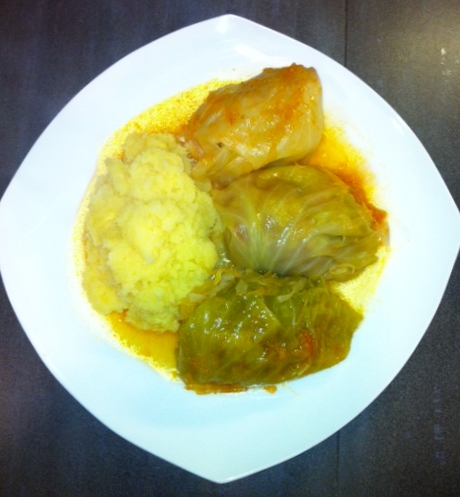
sarmale (cabbage rolls), mamaliga (polenta), and cozonac (sweet bread)
sarmale and mamaliga
A quick search on the internet for “Romanian Cuisine” results in a number of reminiscing Romanians sharing their memories of holiday dinners that include sarmale, mamaliga, and cozonac.  Sarmale is the dish that everyone’s grandmother made for special occasions and even casual family gatherings, and I found it interesting that most accounts regarding sarmale adamantly state that these cabbage rolls are nothing like Polish-style cabbage rolls.  After a little research, I discovered a few differences. The most significant difference is the Romanians’ use of sour cabbage leaves, instead of fresh cabbage leaves.  Romanians also primarily stuff their cabbage rolls only with ground pork whereas most recipes for Polish cabbage rolls use beef or beef with a combination of other meats.  In addition, Romanians layer smoked pork (fat, ribs, or sausage) between the cabbage rolls for added flavor in the dish and generally include dill, dried or fresh, in the bottom of the pot.  I did not find any full heads of sour cabbage to make my sarmale, so I followed the recommendations of several Romanian-Americans who note in their recipes that layering sauerkraut between the cabbage rolls made with fresh leaves incorporates the sour flavor into the rolls.  For the filling, I sautéed onions, celery, bacon, salt, pepper, paprika, and parsley together and mixed it with ground pork and rice after it cooled.  To cook the rolls, I placed a layer of fresh dill in the bottom of a dutch oven.  I layered the cabbage rolls with sauerkraut and thin slices of salt pork, and then I poured tomato sauce over the rolls and filled the pot with just enough water to cover them.  After bringing the stock to a boil, I reduced the heat and simmered the rolls a little over two hours.  I served them with sour cream and mamaliga, which is just yellow cornmeal and water.  They were delicious, but I must admit that while I tasted the sourness and the smokiness, I didn’t think that it changed the flavors that significantly from the Polish cabbage rolls I’d previously eaten without those elements.  Had I grown eating cabbage rolls as part of my normal diet, I’m sure my opinion would be different.  (I’m guessing that someone from Romania might find my strong opinions about barbecue to be a bit overstated, as well.)  Opinions aside, these cabbage rolls were great.

cozonac
Cozonac is a popular sweet bread served during the holidays.  (Cozonac is the name for Romania’s version.  In Bulgaria, it is called kozunak. Both breads are basically the same as Italian panettone.)  This sweet yeast bread is made with milk, sugar, eggs, butter, and raisins in its most basic presentation.  Variations exist throughout the country depending on regional preferences and can include the addition of Turkish delight, orange zest, lemon zest, walnuts, hazelnuts, vanilla, and rum.  Sometimes, the bread is filled with a mixture of ground walnuts, poppy seeds, cocoa powder, rum, and raisins.  During the Easter holiday, the bread is filled with farmer’s cheese and called pasca.  I made a version which included golden raisins, lemon zest, rum, and vanilla.  The dough is extremely sticky, which makes it a little difficult to work with, but other than that, it is a simple yeast bread that even a novice baker could easily make with successful results. By all means, this is more a bread than a dessert, but it is just sweet enough that it makes a nice dessert with coffee.  Even better than dessert, I made French toast with it the next morning.

While I may have begun this journey questioning my decision to plan a week of Romanian cuisine, I certainly ended the week with a serious respect for Romania’s dishes.  I’m still telling people about the flavor of the broth in the ciorbă, and I suspect I will continue to do so.  This is one of those weeks that speaks to the heart of this project as I truly discovered new flavors and dishes previously foreign to me and now a cherished part of my culinary journey. 

Wednesday, December 5, 2012

Week 46: A Journey to Italy

For months, I stared at the word Italian written across this week’s schedule and considered how I might approach the week with the necessary and appropriate reverence befitting such a beloved cuisine.  With a history that spans over two thousand years, the spirit of this cuisine which embodies the idea of cooking with fresh, local ingredients progressed as new ingredients and new ways to preserve food evolved in its regions.  Although Italian cuisine immediately evokes the idea of pasta and tomato sauce for many, its true dishes are not far removed from those that American households have served for years.  While I’ve noted previously that Italian cuisine is the only “non-Southern American” food my mom ever served in our East Tennessee kitchen, I had not considered just how much Italian cuisine truly influenced our table.  Although I was referring to the fact that mom made spaghetti, lasagna, and manicotti, most of the other dishes she served are rooted in Italian cuisine, as well, such as braised roast beef, fresh vegetables from the garden cooked with pork, and baked chicken coated in bread crumbs.  Even those bologna sandwiches and sloppy summertime tomato sandwiches made with tomatoes picked fresh from the vine could be categorized as Italian (minus the Miracle Whip component of our versions).  At its heart, the American table is more influenced by Italian cuisine than any others.

With a limited amount of time for cooking this week, I created a menu for a full traditional Italian meal celebrating fresh, seasonal ingredients.  Although I already had a few dishes planned, I turned to my copies of Mario Batali’s Molto Italiano: 327 Simple Italian Recipes to Cook at Home and Babbo Cookbook for the inspiration I needed to realize the complete menu.  After thoughtful consideration, I crafted a menu for an Italian Autumn Feast and invited over a few friends for Sunday Supper.
negroni

The apertivo is a pre-dinner drink served to introduce a meal.  It may be as simple as a glass of prosecco, but Italians often indulge in a cocktail made with Campari.  The Negroni is likely the most popular Campari cocktail.  It is made with gin, vermouth, and Campari and generally garnished with an orange peel.  This is not a cocktail for the faint of heart as it boasts a strong, piney flavor, and it is best defined as a a “sipping” drink.  For our dinner, half of the guests indulged in a Negroni while the others enjoyed a glass of prosecco.


frying the suppli di riso
The antipasto course offers guests an array of snacks that may range from a simple platter of cheese and meats to more elaborate salads and sandwiches.  A few weeks before our Italian dinner, my friend Stephanie told me about the suppli di riso (fried stuffed risotto balls) that she had in Italy while visiting with her friend Marco’s family.  She graciously asked Marco for his mother’s recipe so I could make it for our dinner, and a few days later I received an email that began with Marco’s family recipe in Italian and ended with his English translation.  
suppli di riso

Marco’s mother makes this dish with risotto flavored by homemade chicken stock and stuffs it with fresh mozzarella and prosciutto.  What an incredible dish!  It was also surprisingly simple to incorporate into the meal.  I made the risotto on the Saturday afternoon.  Then, I formed the risotto balls and stuffed them with the prosciutto and fresh mozzarella on Sunday afternoon, so the only task during the meal was to coat them in egg and bread crumbs before frying them. 

 
sauteed green and black olives
in tomato sauce
Because I knew the suppli di riso would require my full attention, I opted to serve two dishes that could easily be prepared before my guests arrived, such as sautéed black and green olives in tomato sauce and fresh herbed ricotta cheese served with homemade boules.  The recipe for the olives came from Batali’s Molto Italiano.  I made the tomato sauce on Saturday (enough for this dish and the braised veal I served in the secondo course), and on Sunday afternoon, I sautéed the olives with garlic, added the tomato sauce, and simmered them for about thirty minutes.  I served them at room temperature.  
fresh herbed ricotta

Making fresh ricotta cheese was a task I had tackled previously.  It’s simple to make and most recipes for it are similar.  My version is a hybrid of Michael Schwartz and Ina Garten’s recipes.   I just add some freshly chopped herbs, parsley in this case, for flavor and color.  For the boules, I followed Mark Bittman’s recipe in The Best Recipes in the World, and even though I’ve made many homemade breads, I was a little nervous about getting the consistency right when making such a classic bread; however, they turned out beautifully.  I thought two loaves would be enough bread, but everyone loved these boules so much that we ran out of bread before the antipasto course was complete.  They had an incredible crunchy crust with a perfectly tender center ideal for sopping up the tomato sauce with the olives. 

ravioli
The primo course serves as the first course of the actual meal and commonly includes pasta, gnocchi, risotto, polenta, or soup.  This is another course that I planned weeks before our dinner.  I was lamenting over my failed experiences of making homemade pasta with my friend Christine, and she immediately offered to bring her pasta maker to my house and give me a personal pasta lesson.  Fortunately, we had that conversation during my week of French cuisine and I still had some duck confit left in my refrigerator.  She suggested that I freeze it so that we could make duck ravioli.  Brilliant!  So, on Sunday afternoon, Christine arrived with pasta maker in tow, and she proceeded to make beautiful pasta for us.  (It’s so nice to have chefs for friends!)  Watching her work was so much fun…partly because she makes gorgeous food but also because it was nice to take a break from cooking for a minute.  She made a delicious brown butter and sage sauce for the ravioli and then topped each dish with orange zest.  It was amazing! 


duck ravioli in brown butter sauce with sage
The secondo course functions as the main course.  It is generally the heartiest course and includes meat. I made braised veal rolls in tomato sauce from Batali’s Molto Italiano. I thought
 that the stuffing mix of bread crumbs, parmesan cheese, prosciutto, currants, pine nuts, and parsley evoked a sense of Autumn flavors that would enhance our seasonal feast.  I also liked the idea that I could make the dish just before my guests arrived and let it simmer on the stovetop as they enjoyed the first courses of the evening.  To make this dish, I spread the stuffing mixture on thin slices of veal that I rolled and secured with butcher’s string.  In a Dutch oven, I sautéed pancetta and onions in olive oil, and then I browned the rolls in the same oil and removed them.  I added the tomato sauce I made on Saturday afternoon and red wine to the Dutch oven, and then I added the onions, pancetta, and veal rolls back to the pan to simmer for over an hour.  The resulting dish was a tender piece of veal complemented well with the sweetness of the pine nuts, currants and tomato sauce, saltiness of the pancetta and prosciutto, and earthiness of the parsley and red wine.
onions with balsamic glaze
braised veal rolls in tomato sauce
broccoli rabe in the style of Puglia

For the contorno, or accompanying vegetable dishes served with the main course, I selected two dishes from Batali’s Molto Italiano:  broccoli rabe braised in the style of Puglia and onions with balsamic glaze.  The broccoli rabe is braised with garlic and red pepper flakes.  Then, chopped black olives are added just before serving.  The onions with balsamic glaze turned out to be one of the group’s favorite dishes of the evening.  This dish is the ultimate example of Italian cuisine at its best…only a few quality ingredients and time.  I was so proud of the beautiful, thick balsamic glaze on those sweet onions.  Both dishes complemented the veal rolls nicely.

Traditionally, the formaggio e frutta course (cheese and fruit) is served between the main course and the dessert case.  Although I had nice Italian cheeses (parmigiano-reggiano, pecorino, fontal, gorgonzola) ready to serve with some green grapes, I knew that we were nearing our maximum capacity, and I didn’t want to spoil our dolce course, so we agreed to forego this course and move ahead.

pumpkin cake with toasted pine nuts
olive oil gelato
The dolce course is the dessert course and usually includes baked goods such as cake or cookies.  Again, I turned to a Batali cookbook for this course and opted to make pumpkin cake with toasted pine nuts and olive oil gelato from his Babbo Cookbook.  It was every bit as good as it sounds, too.  I loved the pumpkin cake, because it only included one cup of brown sugar which served to elevate the sweetness of the pumpkin puree.  Even better, the cake is studded with toasted pine nuts, golden raisins soaked in grappa, and finely chopped fresh rosemary.  Pairing it with the unctuous olive oil gelato provided the perfect dessert…not too sweet but full of flavor and definitely reminiscent of a beautiful autumn evening. 

I offered espresso for the caffe course, and I intended to ask everyone if they would like some grappa for the digestivo course, but after dessert, I looked over and saw all of my friends lounging across the couches.  We had reached capacity, and even the idea of the digestive was too much.  This is not a group of lightweights either.  None of us is a small portions, calorie-counting, leave food on the plate kind of person, but this feast knocked us out!  Well, except for Patrick.  He even had two servings of the olive oil gelato, and I’m sure he could’ve handled the cheese course, too.  There’s a reason that the Italians reserve these large, traditional meals for special occasions.

I can’t imagine a better way to celebrate the cuisine of Italy than an evening spent with friends around a table of exquisite dishes.   I was so caught up in keeping our dinner on schedule that I completely forgot to document the incredible Italian beer that Patrick shared with the group and the numerous bottles of delicious Italian wines we enjoyed, but they have not been forgotten.  All in all, we had a lovely evening, and the feast was incredible.