Wednesday, April 11, 2012

Week Fourteen: A Journey to Myanmar

Before I organized my schedule for this year’s weekly projects, I scanned through online lists of cookbook titles categorized as International Cuisine.  For the most part, this activity served to assist in creating a concise list of fifty-two countries/cuisines that I probably would have selected without the assistance of a list; however, the multiple titles for Burmese cuisine piqued my interest.  For me, the mention of Burma or Myanmar provokes questions of the political and human interest nature.  With so much turmoil, I had not considered its cuisine as a topic of particular concern, but adding it to my schedule seemed an intriguing way to better educate myself about the culture.  In addition, one must assume that its cuisine will be interesting just by close association with its neighboring countries of China, Laos, India, Bangladesh, and Thailand.

Burmese cuisine’s primary flavoring agents are fish sauce and ngapi, a pungent paste made from fermented shrimp and then sun-dried.  As with most countries, consumption of fish and meat vary based on geography.  Most commonly, inland cities consume poultry and pork, while coastal cities located on the Bay of Bengal serve seafood more often than meat.  The primary proteins eaten within a certain region also vary based on the area’s religious affiliations.  Rice is the most commonly served starch although rice and vermicelli noodles are used consistently in salads and soups.  Tropical fruits are often served as desserts.  Mango is pickled and served as a popular condiment, as well. 

Reading recipes for Burmese cuisine proved to be an interesting study in how a region’s different influences can combine to create dishes that define it because of the combination of approaches and ingredients.  For instance, I would describe Burmese Curry dishes as Indian curries with the addition of ngapi or fish sauce, influenced by Thailand, prepared as a stir-fry, as influenced by China.  This blend of flavors and styles culminates in a distinctly Burmese-flavored dish.

As I approached my menus for the week, I considered my goals for the week. 
  • Incorporate ngapi in as many dishes as possible since it serves as the primary flavoring agent in Burmese cuisine. 
  • Make a Burmese Curry to experience the flavor profile of a curry influence with Thai and Chinese flavors and styles.
  • Read multiple recipes for Mohingar, Myanmar’s National Dish, to determine the most commonly used ingredients to create this diverse, regionally-influenced dish.
Breakfast for Dinner:  Mohingar
As a child, I was always excited to find out that our dinner would be breakfast.  Sausage, biscuits, sausage gravy, and eggs scrambled in the sausage fat fit the bill for a dinner where no one complained.  When I read about Myanmar’s national dish, Mohingar (also Mohinga), traditionally served as a breakfast dish, I just decided that we would be having breakfast for dinner one night of the week, because there was no way I could manage this dish before work.
The base of Mohingar is fish stock and fine noodles.  The herbs, spices, and garnishes served with the dish are determined by the chef’s regional origin.  The variations of the dish differ so greatly that urban street vendors often display signs showing the chef’s name and native region to indicate which particular version is served at a cart.  After reading several recipes and bloggers’ personal accounts about its significance, I selected a recipe from a blogger who wrote about his fond childhood memories of morning visits to a mohingar stall near the Shwedagon Pagoda.  He notated that every family has its own variation of the dish, and I chose to make his family’s recipe.  (Unfortunately, the blog has been offline for the last three days, so I have not provided links to the recipe in this posting.  I'm so glad I save a copy of the recipe when I read it the first time!)

I began with a broth made from fish, lemongrass, and turmeric.  The dish's strong flavor profile is imparted by a caramelized paste of onion, garlic, fresh ginger, lemongrass, dried chiles, shrimp paste, paprika, and turmeric.  Flaked pieces of the fish are added to the paste and cooked for about fifteen minutes in order to take on the fragrant flavors of the paste.  To make the soup, the reserved fish stock, a slurry of rice flour, and the soup paste/flaked fish are added to a stock pot and brought to a boil.  Traditionally, banana stems are added and simmered until tender, but without banana stems I added the recipe’s recommended substitute of whole, peeled shallots to the broth.  Fish sauce and black pepper are added at the end for final seasoning.  To serve the Mohingar, ladle the soup over a handful of cooked rice noodles in a bowl.
The garnishes served with Mohingar vary based on regional traditions and on what products are in season.  Based on the numerous listings of garnishes I read, I am fairly confident that the most often used garnishes include sliced boiled eggs, fritters (either gourd or onion), fresh cilantro, and lime.  I also found the following recommendations:  fried garlic, split pea fritters, chili flakes, shredded green beans, sliced scallions, and fish sauce.

All in all, I really enjoyed this dish.  As mentioned in previous postings, I generally do not like fish soups or stews, but the creaminess and balance of flavors produced a delightful, filling main dish.  So good that the hubs went back to the kitchen to finish everything left.  I served it with hardboiled eggs, cilantro, lime wedges, and onion fritters.  The hardboiled egg was the only garnish that did not make sense to me.  I tried a little crumbled on the soup, and I tried a bite as I was eating the soup.  In both cases, it seemed a heavy addition that did not provide an interesting contrast in flavor or texture to the main dish.  The cilantro and lime complemented the richness of the soup by added a fresh, tart aspect.  I crumbled part of an onion fritter on top of the soup, and that was a really nice touch. 

Traditional Dinner
A traditional dinner includes soup, meat curries, steamed rice, and ngapi yay served with raw vegetables.  For our dinner, I served soup, meat curries, and steamed rice.  After countless searches for more information about ngapi yay, I found that it is a dipping sauce seasoned with ngapi (shrimp paste), but I could not find any recipes or formulations for what actually makes ngapi yay.  I gave up on that aspect and focused on the other elements.  As I prepared for this meal, I discovered that www.101cookingrecipes.com has an extensive listing of recipes for Burmese cuisine, which I used as guidelines for the Chin Hin, Chicken Curry, and Pork Curry.
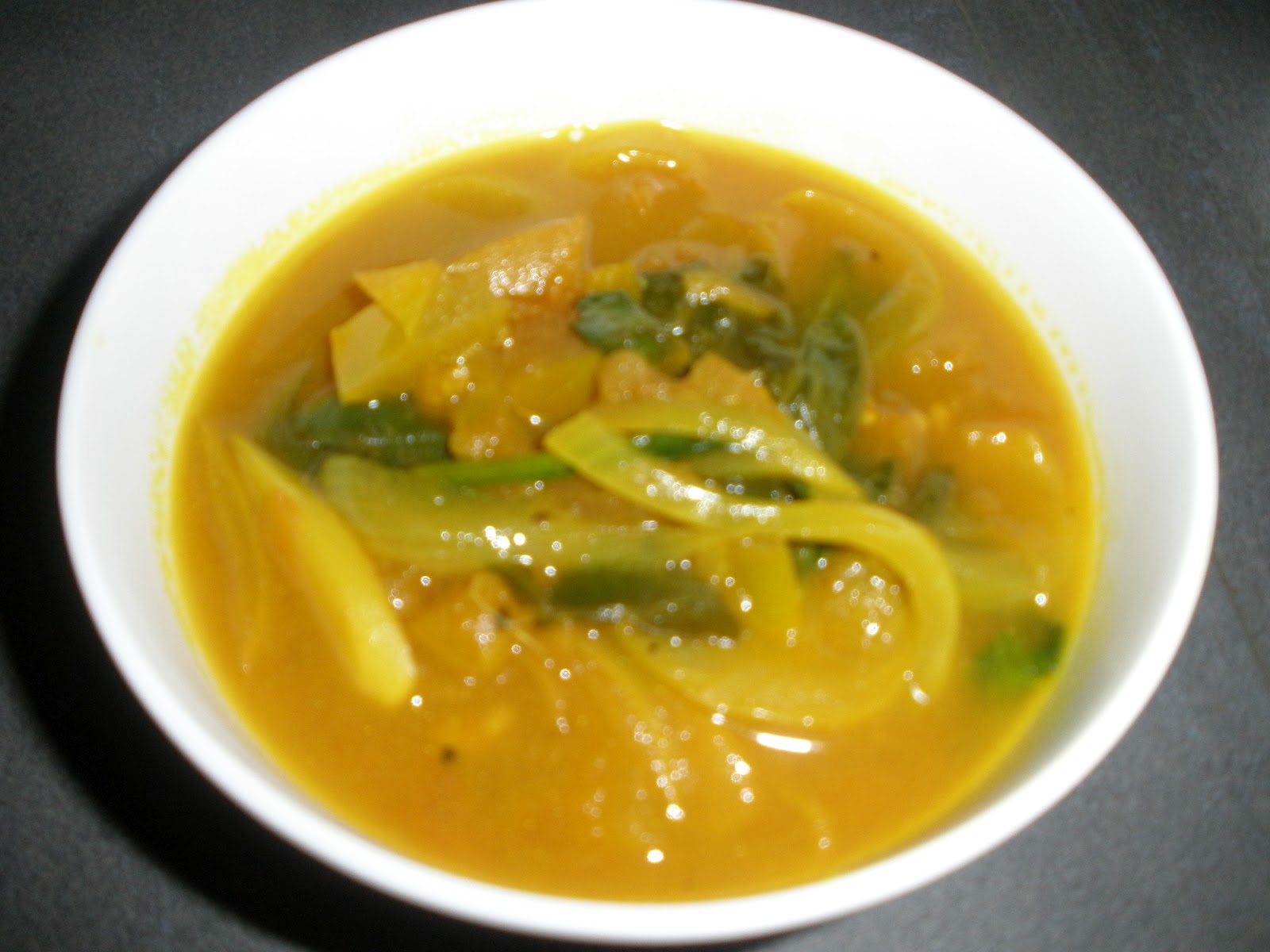
Chin Hin is a “sour soup” served at the beginning of a meal.  I read several different recipes and discovered that the sour elements may be delivered by various ingredients:  sorrel leaves, green tomatoes, tamarind, and even rhubarb.  For my preparation, I made a tamarind broth and added onion, turmeric powder, green tomato, and fresh spinach.  While I found the flavors to be interesting, this was not a soup I could eat in large quantities.  After a few spoonfuls, I was overwhelmed with its sour, bitter quality.


The bright, fresh flavor of this Chicken Curry resulted from the use of multiple fresh ingredients to create its flavor profile:  thin slices of fresh Serrano chiles, grated gingerroot, onions, garlic, tomatoes, lemongrass, and lime juice.  For this curry, the addition of turmeric and cardamom provided the “curried” seasonings.  It also included fish sauce, which offered an interesting background flavor and gave the dish a different profile than an Indian curry.


The Pork Curry included several of the same ingredients (onion, garlic, fresh gingerroot, turmeric, and lemongrass), but its flavors differed significantly from the Chicken Curry.  The addition of brown sugar, curry paste, ngapi, dried chiles, and soy sauce resulted in a dark, rich sauce with a depth of flavor similar to mole.  With every bite, I tasted something new.  I loved this dish!


After a week, I’m still not sure if I should be calling this Burmese cuisine or Myanmarese cuisine, but I am confident calling it unique, interesting, and delicious.  This week’s meals felt more experimental than others, perhaps because I was familiar with the ingredients but not their composition as it relates to this cuisine.  In the case of Burmese cuisine, the whole is certainly greater than the sum of its parts.

Monday, April 2, 2012

Week Thirteen: A Journey to Hungary

I began this week’s discovery of Hungarian food with minimal knowledge and, in all honesty, minimal enthusiasm.  By week’s end, my attitude changed as I discovered Hungarian cuisine's rich flavor profiles and exquisite baked goods.

Because of the Magyars’ nomadic lifestyle, they depended on their livestock as a primary source of food, which is why meat is so prevalent in many Hungarian dishes.  The Turks introduced paprika into Hungarian cuisine.  Hungarians learned to use garlic, onion, nutmeg, and fruits in their cuisine as a result of Western influence.  Other common ingredients found in Hungarian cuisine include sour cream, walnuts and hazelnuts, smoked bacon, cabbage, tomatoes, dumplings, butter, eggs, vinegar, and pickled vegetables.

Lunch is the largest meal of the day, and typically includes an appetizer, soup, main entrée of meat served with a salad, and dessert.  Sometimes, fruit may be served after dessert.  This week, I prepared one large feast based on this progression.  In all honestly, I’m not sure how anyone could successfully host such an elaborate lunch on a consistent basis.  I worked on this single meal periodically for two days.  Thankfully, we enjoyed it and even relished in its incredible flavors!

Appetizer:   Savory Crepe filled with Veal, or Hortobágyi palacsinta

The actual translation for this dish is Pancakes of the Hortobagyi, a group of people living in the Hortobagy region of Hungary.  I found conflicting information regarding its origins.  Some claim that its origin is in the Hortobagy region, while others state that this famous dish’s invention is attributed to the 1958 Brussels World Fair and does not originate from Hortobagy at all. Either way, the dish is delicious.


In Hungary, pancakes are served exclusively as desserts, not as breakfast.  The only exception to the dessert rule is the savory Hortobagyi palacsinta, a crepe stuffed with stewed veal, onions, and tomatoes.  Hot paprika, salt, and pepper season the meat.  After stewing the meat, onions, and tomatoes, the liquid is drained and mixed with flour and sour cream to create a cream sauce for the crepe.  My guests laughed that this meaty dish was only the opening dish for our Hungarian meal, but we all agreed that it was a great way to start the meal.
Soup:  Chilled Sour Cherry Soup
Interestingly, my American cookbooks include this in “Desserts” chapters although Hungarians clearly serve this as part of a traditional soup course.  While researching Hungarian cuisine, I found June Meyer’s Authentic Hungarian Heirloom Recipes website to be a great source of information, and I turned to it for a traditional Sour Cherry Soup recipe.  The combination is primarily flavored with sour cherries, sour cream, and sugar.  I found other variations including the addition of red wine, cinnamon, and cloves, but I opted with the basic traditional recipe.  The soup is surprisingly light, and it served as a great transition dish between the veal crepes and the next course of Chicken Paprikas.
Entrée:  Chicken Paprikas served with dumplings and Cucumber Salad

Because I used Hot Paprika for flavoring in the crepes, I opted to make chicken paprikas with mild, sweet Hungarian paprika.  The dish includes chicken cutlets served in a sauce of sour cream, paprika, and onion.  (Sound familiar?)  In most recipes for chicken paprikas, the notes stated to serve the dish with dumplings tossed in the sauce, so I followed those guidelines and made spaetzle (much more successfully than I did in my week of German cuisine) to toss in the cream sauce.


Serving a simple salad with meat is an imperative in Hungarian cuisine and tradition.  One simple salad that consistently reappeared as I reviewed Hungarian salads is Cucumber Salad with Sour Cream.  I chose June Meyer’s recipe, which includes a simple dressing of garlic, vinegar, sugar, salt, black pepper, and sour cream.  I was surprised at how well this salad complemented the chicken paprikas.  Even with its inclusion of sour cream, it provided a surprisingly light and refreshing escape from the heavier paprika cream sauce. 
Dessert:  Chocolate Orange Dobostorte

Without a doubt, this is my greatest dessert triumphant during my project.  The Dobostorte is named for its inventor, a well-known Hungarian pastry chef named Jozsef C Dobos.  The cake includes multiple layers of sponge cake and chocolate buttercream topped with a single layer of caramel.  A unique element is the layer of caramel atop the cake, which was added as a strategy to seal the cake so that it maintained its moist layers. 

For my presentation, I turned to my favorite yellow Gourmet Cookbook and crafted a Chocolate Orange Dobostorte, which included an orange glaze of melted orange marmalade and Grand Marnier to moisten each layer of sponge cake.  This cake is definitely deserving of its reputation for being served at special occasions…in part because its layers are so rich and luscious, but also because of the four-hour timeline from start to finish for the entire endeavor.


Despite the fact that I served only one Hungarian meal this week, I am confident that its complexities taught me more about the style of cuisine than I’ve learned in other weeks with several small menus.  We enjoyed every dish, and even as I write this blog posting, I’m craving that sauce of paprika, sour cream, and onion.  The good news is that we have two leftover pieces of dobostorte waiting in the refrigerator for tonight’s dessert.

Monday, March 26, 2012

Week Twelve: A Journey to Norway

I began this week’s culinary exploration of Norway with only one thought:  salmon.  Otherwise, I opened my mind to new experiences and flavors for an interesting journey.  As with many cultures, the key components of Norwegian cuisine directly relate to the geographic terrain of the country.  Norway’s coastline stretches over 15,000 miles, not including the coastlines of its 50,000 islands located off the rugged mainland coast.  These coastlines resulted in a strong presence of salmon and cod in Norwegian cuisine.  The cold weather also led Norwegians to creative solutions for maintaining their large harvests of fish, which explains their affections for fish that has been smoked, cured, pickled, fermented, and even lyed as with the infamous lutefisk.  In addition to its vast coastline, Norway’s terrain includes the Scandinavian Mountains.  Because of its mountainous landscape, Norway is a popular area for mushroom foraging, primarily chanterelle mushrooms.   In the Northern regions, game hunting is a popular sport, which is why moose, wild reindeer, deer, grouse, and hares are commonly found in the everyday cuisine of that area.  In addition to fish and wild game, Norwegian diets commonly include lamb, pork, and mutton.  Meatcakes and mutton stew represent the most popular and notable dishes of farmed meats.  Milk plays an important role in the cuisine, and early Norwegians approached it in the same manner as fish by converting fresh milk to butter, buttermilk, and cheeses for longer storage times.  Famous Norwegian cheeses include Jarlsberg (similar to Swiss cheese) and gjetost (a soft brown cheese made of milk, cream, and whey).  The cold weather dictates that most vegetables come from the ground, and the berries, though not abundant, are prized for their piqued sweetness. 

Beyond everyday cuisine, Norwegians treat Christmas as a food holiday.  On the coast, fresh cod, halibut, and lutefisk are served on Christmas Eve; while on the mainland, Norwegians enjoy pork ribs and sausages.  On the West Coast, dried mutton ribs are a Christmas specialty.  In addition to Christmas meals, the tradition of families making seven kinds of Christmas cookies endures.  The traditional cookie spread includes gingersnaps, butter cookies, cookies in cone shapes, and cardamom-spiced cookies. 

With so many options, I planned menus to celebrate the cuisines of the coastlines, the mountains, and the holidays.


Wednesday Night Dinner:  Torsk (Cod) with Egg Sauce & Braised Leeks
After reading that cod is the most consumed fish in Norway, I planned to make it for a weeknight dinner.  As I read through Norwegian blogs and websites, I found several mentions of the dish Torsk Med Eggsaus as a favorite.  The dish includes poached cod with an egg sauce made from butter, hard-boiled egg, tomato, parsley, and chives.  Right away, I was intrigued by the sauce.  When I read “egg sauce” in the title, I thought it would be a hollandaise, and I was shocked to read that it included hard-boiled egg.  I served braised leeks with lemon as a side dish in order to balance the richness of the sauce.  We enjoyed this meal.  (The egg sauce was beyond rich!)  I felt like it gave me a taste of Norwegian cuisine, but it didn’t wow me to the point of wanting more.


Friday Night “Snack Supper”:  Gravlax with Mustard Sauce
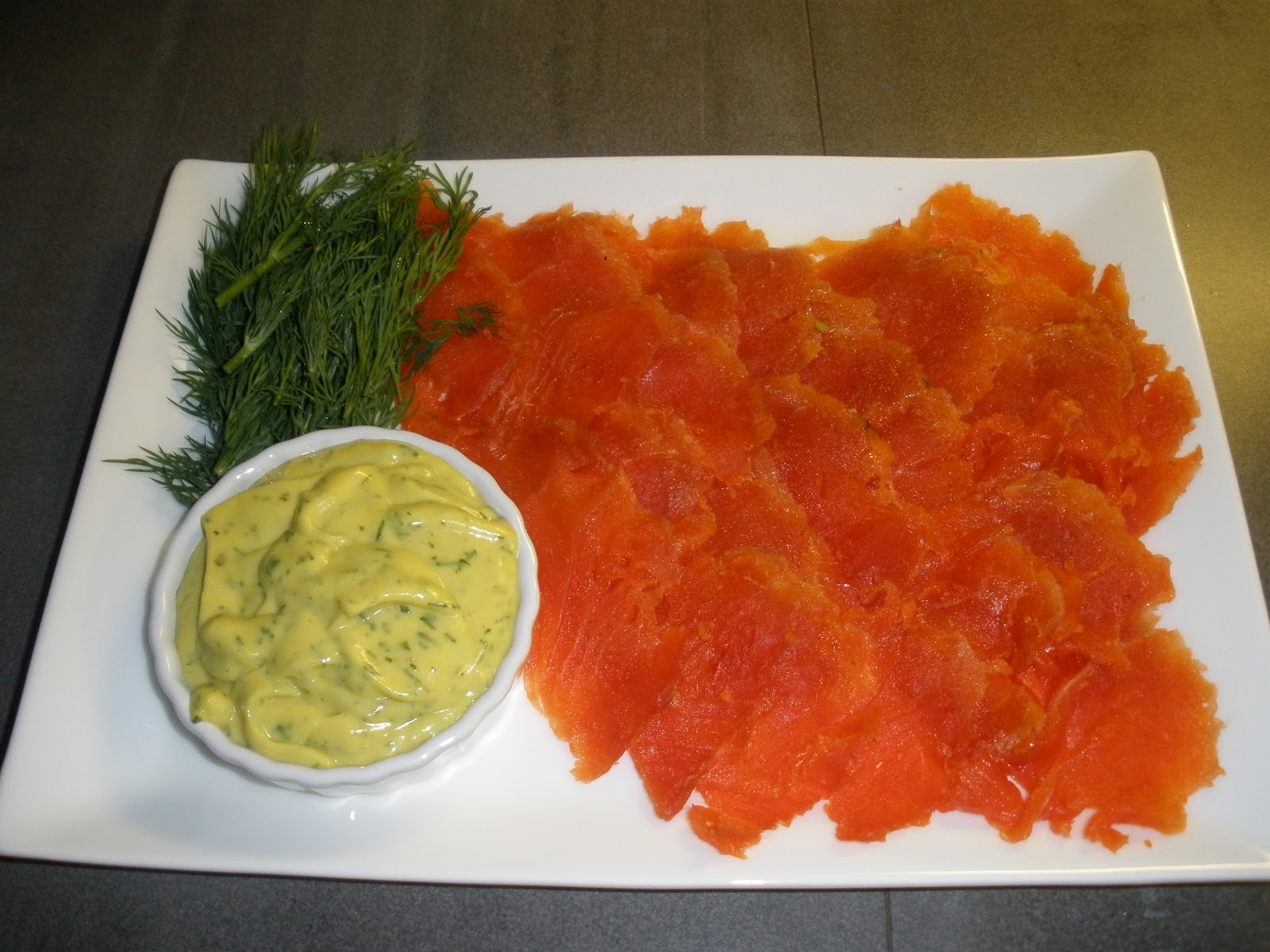
When I saw Norway on my calendar for this week, I knew that homemade gravlax would be in my future.  On Wednesday, I bought a beautiful piece of wild-caught sockeye salmon and piled it high with a mixture of sugar, salt, dill, lemon zest, bay leaves, and black pepper.  It cured in the refrigerator for 48 hours, and the resulting gravlax tasted amazing.  The real key to this dish is slicing it as thinly as possible.  If the slices are thick, the texture is chewy and gummy.  I made a mustard dill sauce with Colman’s mustard, mayonnaise, dill, salt, and pepper to serve with the gravlax.   Then, we turned on March Madness basketball and sat down on the couch for a snack supper buffet of gravlax, mustard dill sauce, and thinly sliced whole grain bread.  A pretty nice Friday night!

As a side note, I planned for us to enjoy Aquavit martinis with our little spread, but after tasting Aquavit, I decided that I would leave it to the Scandinavians for their martinis.  Not a flavor I enjoyed!  I’ll stick with my Grey Goose.


Saturday Afternoon Snack: Gjetost, a.k.a Norwegian Fudge Cheese
I discovered a new love:  gjetost!  Imagine a slab of gooey, creamy caramel that tastes a little like cheese.  That’s the best way I can describe it...more like caramel than cheese.  I could only eat a few slivers, because it is one of the richest cheeses I’ve ever tasted.  I highly recommend a trip to Whole Foods to buy a block of this.  It’s worth the extra effort to try out!


Saturday Night Dinner: Juniper-Spiced Venison, Mashed Rutabaga, and Sautéed Mushrooms
Over the holidays, I received a random text from my husband stating “Rick just gave me venison steaks from his brother.  I told him you would be excited.”  He was so right about that.  I’ve been saving them for the perfect occasion, and after reading about the popularity of wild game in Norwegian cuisine, I knew the time had arrived!  Norwegian recipes for wild game generally include rich sauces and strong spices, such as juniper berries, to balance the distinct flavors of game.  I confidently selected Andreas Viestad’s recipe for Juniper-Spiced Venison with Brown Goat Cheese Sauce as a vehicle to discover these Norwegian flavors.  In addition to sounding delicious, it included gjetost and aquavit in the sauce, which I had been planning to buy for this project anyway.  The venision steaks I had were thinly sliced, so I cooked my steaks for a much shorter time period than directed in the recipe.  Otherwise, I followed it precisely.  I served the venison with mashed rutabaga and sautéed mushrooms as they are common side dishes in Norwegian fare.  Unfortunately, I did not have the traditional chanterelle mushrooms available, so I used crimini mushrooms.  Of course, I also included lingonberry preserves on the plate as an accompaniment to the venison steaks.  That’s a “must have” in Norwegian cuisine.

We loved this meal.  The flavors of the juniper spice rub, the creamy sauce, and lingonberry preserves perfectly complemented the venison.  The only thing I will change when I make it in the future is to add less Aquavit to the sauce, because that step thinned out the sauce more than I preferred. 

Sunday Afternoon Snack:  Pepperkaker

After reading about Norway’s Christmas Cookie obsession, I knew I had to make at least one Norwegian Christmas Cookie recipe for the project.  I selected Pepperkaker because of its interesting spice combination, including cardamom which is commonly used Norwegian desserts.  I also thought the inclusion of fresh ground black pepper would be interesting in the flavor profile.  I’ve made ginger cookies with black pepper in them previously, and while it may sound odd, it adds a bit of heat to the cookie that is addictive.

The recipe is a simple butter cookie recipe with minimal sugar included.  (Most Norwegian desserts include only small amounts of sugar because it was so expensive for Norway to import before modern times.)  The recipe also includes cinnamon, cardamom, and black pepper.  As I pulled the first baking sheet out of the oven, the aroma surprised me.  They smelled amazing, but there was something peculiar and familiar that I couldn’t quite figure out.  I tasted one and liked it.  At first, the flavor was all butter cookie.  Then, there was a recognizable aftertaste…similar to the aroma….what was it?  AHA!  Biscuits and gravy….no joke!  These cookies taste like biscuits and gravy.  Most of the cookie is flour and butter with a strong freshly ground pepper presence, which is essentially biscuits and gravy:  flour, fat, and pepper.  I still liked the cookies, and I even had them with coffee on Monday morning, but I can’t escape the biscuits and gravy reference.  Definitely odd for a cookie!

My Norwegian journey turned out to be much more exciting than I originally expected.  I will repeat the venison spiced with juniper and cheese sauce.  Gjetost will be served on future cheese platters for guests (and me), and I will make gravlax for a party.  As for the “biscuits and gravy” cookies, I probably won’t include them in Christmas cookie and candy making plans this year, but I will certainly remember them fondly!

Monday, March 19, 2012

Week Eleven: A Journey to Colombia

Without a doubt, this week’s Colombian journey proved to be the most personal of my project to date.  Instead of researching online and reading recipes in my cookbooks to better understand Colombian cuisine’s unique qualities, I simply turned to friends and co-workers with family roots in Colombia.  Sure, I looked around online, but for the most part, distinguishing Colombian food from that of other Latin American countries is difficult from the perspective of someone reviewing recipes and reading about key ingredients.  Rice, beans, plantains, yucca, chicken, fish, pork, tomato, onion, and garlic are the key ingredients for the cuisines of most Latin American countries, so I knew this week’s journey would only be complete if I understood which dishes connect emotionally with my Colombian friends. 

A few weeks ago, I turned to my friend Bonnie whose dad lives in Colombia, and I asked her to think of some dishes that I should make for my upcoming week of Colombian cuisine.  Without hesitation, she responded that I had to make Bandeja Paisa.  A week later I asked the same question of my friend John who lived in Colombia as a child, and he responded with the same dish…Bandeja Paisa.  He found a picture of it online for me and described its components with excitement.  A few days later, I told my friend Scott who is also Colombian that I was planning to make Bandeja Paisa over the weekend, and he explained the dish with such fervor that our conversation ended with him saying he was going out for Bandeja Paisa that night. 

Bandeja Paisa includes many components, so I knew this would be a dish I needed to save for a weekend when I had extra time.  I wanted to include another dish, so I read about several different soups and stews that I could make as a weeknight dinner.  I decided to make Ajiaco, which is a traditional Andean stew of chicken, corn, and pappas criollas (Andean potatoes).  A Colombian herb called guascas provides Ajiaco’s distinct flavor profile.  Upon making my decision, I mentioned to John and Bonnie that I needed to find guascas and pappas criollas at a local market so I could make ajiaco.  Neither seemed excited about me making this dish (which should have been clue #1 that I needed to make something else), but they agreed that I should be able to find the special herb and potatoes at a local market in Little Havana.  So, I set out on a mission after work on Monday night, and after visiting four different markets in Little Havana, I only found the pappas criollas.  No guascas in sight.  I made plans to try a market near my office during lunch the next day.  Tuesday morning, John and Bonnie asked how the ajiaco turned out, and I reported to both that I couldn’t find the guascas and hoped to find it on my lunch break.  Then, John said, “Why don’t you just make sancocho?”  My response was simply that I didn’t know what it was, but I immediately understood that when your Colombian friends aren’t excited about a dish you plan to make but ask you why you aren’t making something else, change course!  John explained the dish to me, and Bonnie talked about the tradition of building a big fire on the beach to make a huge pot of sancocho in Colombia.  I knew that I had to make the sancocho.  Thankfully, it does not have guascas in it, so I ended that scavenger hunt immediately.

With my menus for the week set, I set out to make Colombian dishes with heart.  I found a website My Colombian Recipes, which provided me with great background information about the dishes as well as traditional presentations and recipes.

Tuesday Night Dinner / Wednesday Lunch:  Sancocho de Gallina
With inspiration from my friends, I set out to make traditional sancocho that would enlighten me and provide warm memories for my friends.  I knew that the stew would be more than I could eat alone on Tuesday night, so I told them to plan for sancocho lunch on Wednesday at work.

I made the Sancocho de Gallina recipe posted on My Colombian Recipes.  The stew includes chicken, fresh corn, green plantains, potatoes, yucca, and cilantro with chicken bouillon, salt, and pepper used as seasonings.  I was surprised to find that it only took an hour to cook the stew, and I was astonished at how much flavor was imparted after only one hour of stewing.  I served it with white rice and avocado on the side as is traditional. 

When I presented the dish to John, Bonnie, and Scott, I asked them not to tell if it was good, but to tell me if it tasted like what they know as sancocho.  They all agreed that my sancocho hit the mark.  John even told me that no one’s sancocho could ever be as good as his mom’s, but mine came close.  That is the highest compliment you can receive, so I graciously accepted it.  What a great way to spend a Wednesday lunch hour!

Sunday Night Dinner:  Bandeja Paisa
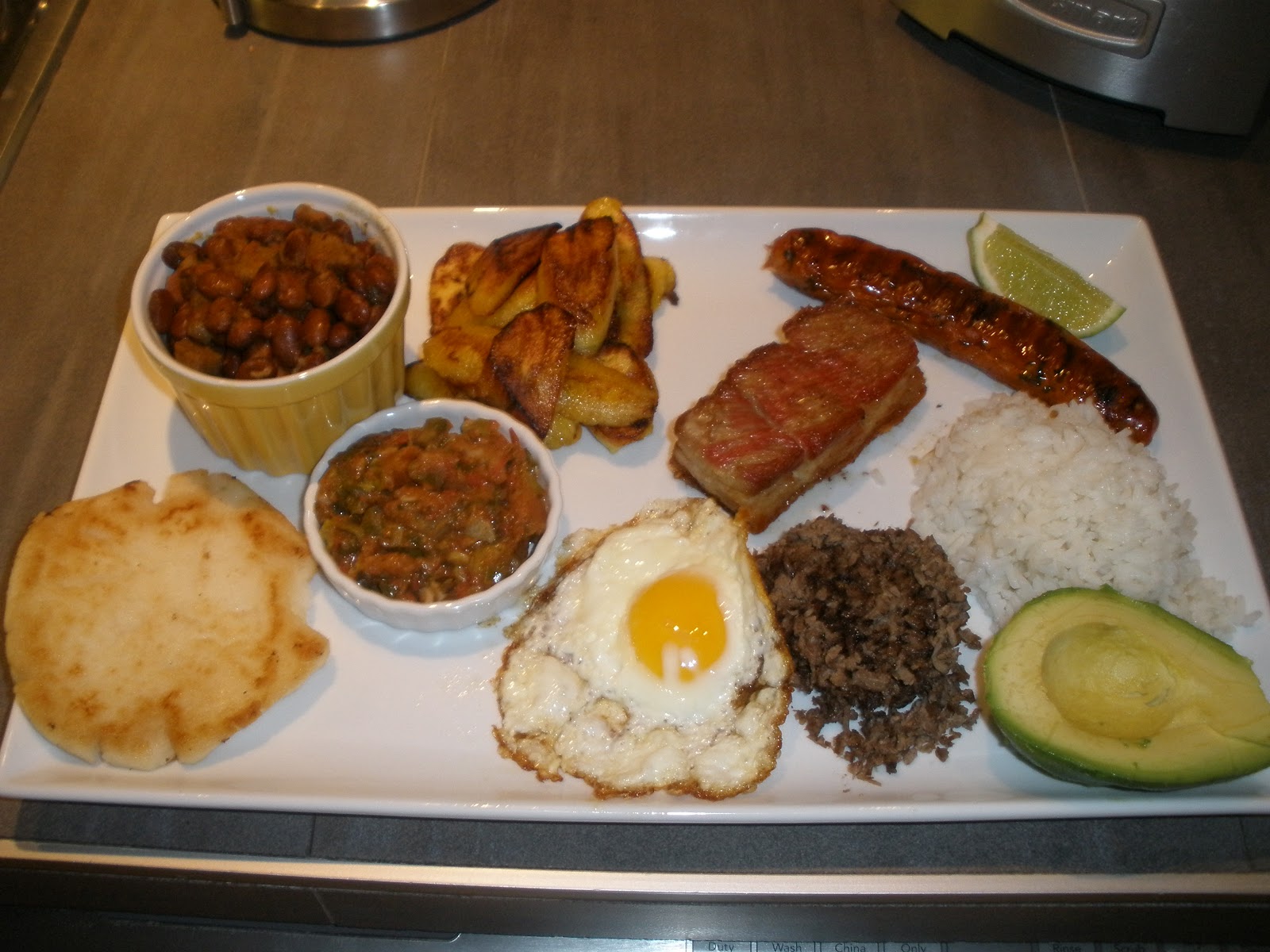
The basic translation of Bandeja Paisa is Tray of the Countrymen.  To my Colombian friends, this is the piece de resistance, a raison d'être, the Holy Grail.  For a week, I’ve called it The Heart Attack Platter, because it includes a list of items that a heart surgeon would warn against eating alone, much less all lined up together on the same plate.  I forged ahead with my plans to make the dish that my makes my friends swoon.

I turned to My Colombian Recipes for her presentation of Bandeja Paisa as my guideline.  I even showed it to my friends to make sure it was the authentic presentation that they envisioned when recommending the dish.  Interestingly, they agreed that it bared authenticity, except for one thing...none of them had heard of the Carne en Polvo (powdered beef).  They noted that a small piece of grilled flank steak was more typical of their experiences with this dish.  Since I have made flank steak many times, I decided to try the Carne en Polvo, so I could report back to my friends about it and experience something new.

The platter includes the following components:  Paisa Pinto Beans, White Rice, Carne en Polvo (Powdered Beef), Chicharron (Pork Belly), Chorizo, Plantains, Arepa, Hogao (tomato and onion relish), Fried Egg, Avocado, and Lime.

I began the process of making this meal on Saturday. 
  • I made the Hogao, which is a relish of scallions, tomatoes, garlic, cumin, and fresh cilantro. 
  • I began soaking the pinto beans.
  • I made the “guiso” which is mixture of tomato, onion, scallions, garlic, cilantro, and cumin that is added to the pinto beans after they cook for two hours.  Oddly enough, it was almost the exact same recipe as the hogao, which is served as a condiment for the pinto beans.
  • I marinated and cooked the flank steak.  Then, I pulverized it in the food processor to turn it into the elusive Carne en Polvo.
On Sunday, I began working on dinner mid-afternoon:
  • I cooked the Paisa Pinto Beans…an almost four-hour process.
  • I made the Chicharron Colombiano using the directions from Nikas Culinaria.
  • I grilled the chorizo.
  • I steamed the rice.
  • I took the Hogao out of the refrigerator so it could warm to room temperature.
  • I made the arepas according to the recipe on the back of the Goya bag.
  • I reheated the Carne en Polvo that I made on Thursday.
  • I fried the plantains. 
  • When I finished frying the plantains, I fried the egg in the same skillet.
  • I sliced the avocado and lime wedges.

Finally, I plated this crazy big platter, and we sat down to enjoy our Colombian buffet at 9:00 PM.  My favorite “bite” on the platter was the Carne en Polvo and Hogao added to the Paisa Pinto Beans.  I enjoyed the fresh-made arepas and plantains, too.  I think I overcooked the chicharron, because it was dry and tough unlike I’ve had it prepared by others.


All in all, my journey into Colombian cuisine proved successful as I tried new dishes and connected with friends in new ways.  I wish my week had allowed more time, because I wanted to make pandebono (Colombian Cheese Bread), a favorite of mine and my Colombian friends.  Another day, another week…

Tuesday, March 13, 2012

Week Ten: A Journey to Ireland

When I lived in Birmingham, Alabama, a group of my friends and co-workers celebrated St. Patrick’s Day each year by piling into The Irish Deli on Green Springs Highway for lunch. We ordered bowls of Irish Stew and laughed with giddy delight as we watched the kitchen hands frantically opening cans of Dinty Moore Beef Stew to fill our orders. We continued this tradition year after year, because the kitsch outweighed the quality of food by a mile. As I began this week’s journey into Ireland, I vowed to discover the more refined points of Irish cuisine.

Although beef and bacon come to mind when thinking of traditional Irish food, the truth is that these meats were most often reserved for the wealthy until the late nineteenth century. Those living near the coastline took advantage of shellfish, such as oysters, mussels, and even lobster. For the Irish living in the hills, cattle-herding was a common occupation, but most of the meat was raised for nobility. (Even today, more than 90 perfect of farmland is used as grazing land for livestock.) The commoners’ diets more likely included offals and dairy products. Dairy products continue to play a prominent role in Irish cuisine. The Irish are famous for their pure butter (with a higher butterfat content than average American butter) and their cheeses, such as Cashel Blue, Duhallow Farmhouse, and Dubliner.

The role of the potato is epic. While it was widely cultivated for the sustenance of both people and hogs, the potato became a core part of the cuisine out of necessity and economic hardship. Because of laws denying the Irish Catholic majority the right to buy land or will it to their descendants, family farms were reduced to small plots, sometimes even less than a quarter of an acre. These families were forced to focus on the cultivation of a single crop that would produce throughout the year, and most Irish chose potatoes to serve that role. Dishes such as colcannon (potatoes with kale and cream) and champ (potatoes with scallions and cream) originated during this time period. The infamous Irish Potato Famine was actually more than one event as it occurred periodically throughout the sixteenth and seventeenth centuries. Because families depended on only one crop, the years with poor potato harvests due to extremely cold weather proved to be difficult. Later in 1845, potato blight spread throughout the farmlands causing even more serious food shortages. Even after so much death, devastation, and more than one million Irish emigrating to new lands, the Irish welcomed back the potato into their everyday cuisine when the blights ended.

Breads and cakes play prominent roles in Irish cuisine, particularly Irish Soda Bread. Although I had heard of Irish Soda Bread, I did not really know exactly what it entailed. After reading recipes in my cookbooks and scanning the internet, I still felt a bit lost because the ingredients varied so greatly. Then, I found the aptly-named website, Society for the Preservation of Irish Soda Bread. This is an entire website dedicated to the tradition of the bread, and they are serious about Irish Soda Bread. After reviewing its “History” tab, I understood quickly that most of the recipes I found online were not traditional at all.  The site clearly states that none of the following ingredients can be included in a traditional Irish Soda Bread: zest (orange or any other kind, Irish Whisky, honey, sugar, eggs, garlic, shortening, heavy cream, sour cream, yogurt, chocolate, chiles, jalapenos, or fruit. Fortunately, all of those delicious ingredients may be included in other baked goods…just not traditional Irish Soda Bread.

As I planned my weekend menus, I considered this history, the use of Irish ingredients, and a mix of traditional and modern interpretations of the cuisine.

Saturday Night Snack: Irish Cheese Platter
Having never specifically sought out Irish Cheese, I thought this would be a great opportunity for a tasting. I made a trip to Whole Foods and bought a wedge of every cheese imported from Ireland: Duhallow Farmhouse, Dubliner with Irish Stout, Aged Cheddar with Irish Whiskey, and Cashel Blue.

Aged Cheddar with Irish Whiskey, Cashel Blue
Duhallow, Dubliner with Irish Stout


The Aged Cheddar with Irish Whiskey had a smooth, nutty flavor. The infusion of Irish Whiskey was mild as I could barely detect its flavors against the sharpness of the aged cheddar.

Cashel Blue is an original Irish farmhouse blue cheese made by the Grubb family on their farm at Beechmount. The cheese has a natural rind. Its creaminess was far beyond any blue cheese I’ve ever tasted, and the intense flavor surprised me.

The Duhallow Farmhouse cheese is semi-soft with a buttery flavor and mild tanginess. It was my favorite of the four. Duhallow is the first authentic farmhouse cheese recognized by Ireland.  It is made on a single farm with milk exclusively from the Burns family farm’s herd sourcing back to 1925 when the family imported Friesians into Ireland.

Dubliner Cheese is a firm cheese with a slightly dry texture similar to cheddar. We had one infused with Irish Stout, and the combination was divine. The sharp nutty flavor of the cheese with hints of caramel and bitterness from the stout provided a delicious balance. This one was also creamy for a firm cheese, which I attribute to the stout.

We also poured ourselves glasses of Bushmills Irish Whiskey with a splash of soda water. It isn’t a traditional choice for me, but I must say I did enjoy it in the spirit of this week’s Irish celebration.

Sunday Morning Breakfast: Irish Soda Bread with Irish Butter

Of course, I turned to the Society for the Preservation of Irish Soda Bread for their recipe. I must say that this was a delicious, moist bread and so simple! Tasting it and seeing its texture, I was shocked at its outcome considering that the recipe does not include any yeast. I followed their directions to make the loaf in a round cake pan with another cake pan over it as a lid to simulate the effects of the bastible pot. We slathered rich, creamy salted Irish butter on warm wedges as soon as it came out of the oven. This is definitely a homemade bread that I will make again.

Sunday Night Dinner: Crab Crème Brûlée, Dublin Lawyer, Champ, and Grandmother Monahan's Irish Whiskey Cake

Paul Flynn is a prominent Irish chef who serves his signature dish, Crab Crème Brûlée, at The Tannery. The dish is based on traditional Irish Potted Crab, which is basically a custard with crab. His recipe includes pickled ginger and garlic which infuses more flavor into the custard. He also recommends homemade pickled cucumbers made with a touch of sweet chile sauce. I followed his lead and made his dish precisely as directed, including the homemade pickles and melba toasts. The result was a delicious first course…actually, the best dish we had on Sunday night. The recipe includes direction to mix the eggs, garlic, pickled ginger, salt, pepper, and crab meat for at least 30 minutes before baking and recommends that letting the flavors meld together overnight is ideal. As I reviewed his recipe, I questioned the use of pickled ginger and thought it would be overpowering, especially if I let the crab crème sit for 24 hours, but this is why I am not the chef. The flavor combination was perfect, and the small amount of pickled ginger was just enough flavoring to add a nice piquancy to the dish.

Dublin Lawyer and Champ
Dublin Lawyer is a dish that combines lobster with a whiskey cream sauce. The story goes that it is so named because it is "rich and boozy" like a Dublin lawyer. By all accounts, every recipe I found online was basically the same with the exception that one editor noted that he recommends Bushmills because he “does not like Jameson’s thin, one-dimensional and cloying sweetness.” (I’m no expert on Irish Whiskey, but based on his recommendation, I did use Bushmills.) The sauce includes shallots, butter, cream, flour, and whiskey. Then, egg yolk is tempered and added at the end. My sauce was luscious and creamy until I added the tempered egg yolk at which point it immediately broke. I didn’t have any extra shallots or even onions to try again, so I decided we would just have to enjoy the flavor in the broken sauce with our lobster. When the hubs asked what we were eating, I told him the story of Dublin Lawyer, and then I explained that I was calling my dish “Dublin Law Student” as it was boozy and broke! I’m pretty sure this dish would have been over the top delicious if I’d gotten the sauce right.

I felt obligated to make at least one potato dish, so I tried out Champ. Simply put, it’s mashed potatoes mixed with cream and butter that have been infused with scallions. Of course, they were tasty…how could they not be? The freshness of the scallions lightens the flavor and adds a nice pungency. This would be a great preparation for mashed potatoes to serve with fish or another light protein.

Irish Whiskey Cakes are traditionally served for special occasions. For many weddings, the top tier of the wedding cake is an Irish Whiskey Cake, which is saved for the Christening of a couple’s firstborn. For me, the special occasion was a gorgeous Sunday evening on our third floor deck with an almost-full moon overhead. I found no shortage of recipes for Irish Whiskey cake. For the most part, each recipe included the same basic ingredients with various combinations for fruit soaked in whiskey. I chose Grandmother Monahan's Irish Whiskey Cake because it sounded the best. I soaked the golden raisins and lemon zest in Irish Whisky for over 24 hours, and I used 2 tbsp of Irish Whiskey in the glaze. The final cake was rich, moist, and perfect with a big cold glass of milk. I took the leftovers to work on Monday morning, and the entire cake was gone within minutes. Definitely a success story…

I enjoyed this week’s Irish Cuisine, and I was pleased to find so many new dishes. The best discovery was the simplicity of Irish Soda Bread, which means I can be make homemade bread quickly and easily any day I choose. On the heels of St. Patrick’s Day, I am inspired for this week’s festivities! 

Monday, March 5, 2012

Week Nine: A Journey to Germany

German cuisine….sausage, sauerkraut, spaetzle, and beer!  At least, that’s what I thought before this week’s foray into German cuisine.  For the most part, my assumptions were correct.  GermanFoods.org boasts that over 1500 varieties of sausage exist and that Germans eat about sixty-seven pounds of meat and sausage products per year.  As much as my husband would’ve loved a week of different sausages every night (okay, I would’ve enjoyed it, too), I wanted to dig a little deeper and discover new dishes.  After all, that is the point of the journey.

While German cuisine is not spicy, its incorporation of white pepper, parsley, marjoram, juniper berry, caraway, chives, and thyme as commonly-used spices certainly informs its flavor profiles.  Mustards and horseradish are popular condiments and serve to complement the seasonings of those many, many varieties of sausages.  Trout is the most common freshwater fish, and fly-fishing for brown trout in the mountains is actually quite popular.  Of course, I knew that cabbages are common vegetables, and recipes for German-style cabbage abound:  boiled, braised, stuffed, and sweet-sour.  I did not know about the white asparagus craze though.  During white asparagus season, the vegetable is so popular that restaurants feature entire menus dedicated to the “edible ivory” as they call it.  In an article titled “Germans Are Obsessed with Asparagus” from Spiegel Online International, Valerie Callaghan recalls how her most reserved German colleagues and friends suddenly came to life with conversation as soon as the season began in mid-April.  She also notes how they dismally lost their social skills when the season ended in November.  Bread is so popular that Wikipedia lists the Top Ten most popular German breads…which must mean that there are at least another ten or fifteen out there, right?  Most breads are made with sourdough and include wheat and rye flour.  For desserts, Germany is known for its cakes and tortes, most famously Black Forest cake. 

As a side note for my Cobaya friends, I was delighted to discover a German dessert called Spaghettieis, which is eerily similar to Michael Blois’ dessert “spaghetti and meatballs” served at the February Experiment.  Spaghettiesis begins with vanilla ice cream pressed through a potato ricer to look like noodles.  Then, the ice cream noodles are covered in a strawberry sauce and toasted coconut to mimic marinara sauce and parmesan cheese.

With family visiting this week and a few after-work engagements, my time for German menus was more limited than usual.  I managed to eke out a Monday night dinner and a Beer & Pretzel night. 


Monday Night Dinner:  Riesling-Poached Trout with Thyme, Sweet and Sour Brussels Sprouts with Fresh Dill, Black Pepper and Chive Spaetzle

This menu represents my attempt to create a sophisticated German-style dinner. 

I opted to make Riesling-Poached Trout with Thyme for several reasons:  trout’s prolific availability in Germany, the inclusion of a German Riesling for poaching, and the challenge of cooking my first whole trout.  The recipe included a quick sauté of leeks and carrot matchsticks served over trout poached in Riesling with fresh thyme.  The simple combination of ingredients and the soft, flaky texture of the fish provided a flavorful and satisfying dish.


Brussels Sprouts are my favorite vegetable, and I am always curious to discover new preparations.  I chose to make Sweet and Sour Brussels Sprouts with Fresh Dill as a more sophisticated option than cabbage.  The sauce included apple cider vinegar, crushed tomatoes, sugar, and chicken broth with cornstarch for thickening.  In all honestly, they were just okay.  Not bad, but not something I will make again. 


For years, I’ve had a complacent attitude about spaetzle.  Those feelings changed when I tasted the cheddar spaetzle served with Guava Chili Pork at neMesis Urban Bistro.  Then, I had squash spaetzle served with roasted antelope at Sustain’s Exploring Burgundy dinner in November, and it blew me away, too.  Both presentations were so unbelievably tender and flavorful!  With inspiration from neMesis and Sustain, I attempted to make Black Pepper and Chive Spaetzle from a recipe in The New York Times Jewish Cookbook.  It was terrible!  I’m confident that the issue is my spaetzle-making skills, not the recipe.  The spaetzle was tough, and I think it’s because I used a metal colander over the simmering water which caused the batter to “cook” and toughen before it even hit the water.  I’ll try again sometime, but for now, I’ll just order it at my favorite restaurants!

Wednesday Night:  Beer and Pretzels

Enjoying hot, soft pretzels from the oven with homemade mustard and cold German beer at home is a little bit of utopia.  I turned to Alton Brown for his Homemade Soft Pretzels recipe.  (I like to use recipes that include specific details about temperatures and weight, not volume, to ensure precise, successful results.)  This recipe was on the mark!  The dough rose perfectly, and the end result was a delicious, tender soft pretzel.


I found a recipe for Beer and Horseradish Mustard on epicurious.com, that I knew would provide the perfect accompaniment to the warm pretzels.  I love the idea of making mustard!  I highly recommend trying this one out, but make sure you plan to make your mustard about 24 hours before serving.  It needs time to set-up.  As for the ingredients in my mustard, I used Ayinger’s Oktoberfest lager for the beer, red wine vinegar, and Colman’s dry mustard.  This mustard is so delicious that I would be happy just slathering it on some white bread for a snack.

Before embarking on my plan for beer and pretzels, I knew I needed a beer expert to provide guidance, so I turned to the author of a favorite blog, The Miami Malt Bomb, for recommendations (with the caveat that the recommendations should be beers I can easily find).  He recommended Weihenstephaner Original and Ayinger Dunkel, and I found both at Total Wine with no issues.  The pairing of the beers with the mustard, not the pretzels, offered the most interesting complements.  By no means do I consider myself an authority on pairing beers with food, but for what it’s worth, I listed my thoughts below:

I enjoyed the earthy flavors of the Weihenstephaner Original with the mustard.  Because the mustard is so full of flavor, this lager’s crispness provided a welcome freshness as a balance.

The caramel flavors and nutty tones of the Ayinger Dunkel complemented the strong flavors of horseradish and caraway in the mustard.  The “bready” flavor of the beer also tasted great with the soft pretzels.


I may not have been as adventurous with German cuisine as in previous weeks, but I learned to appreciate new flavor profiles and dishes from Germany that I did not know when the journey began.  Because of that, I will call this week a success….even if I can’t make tender, delicious spaetzle!